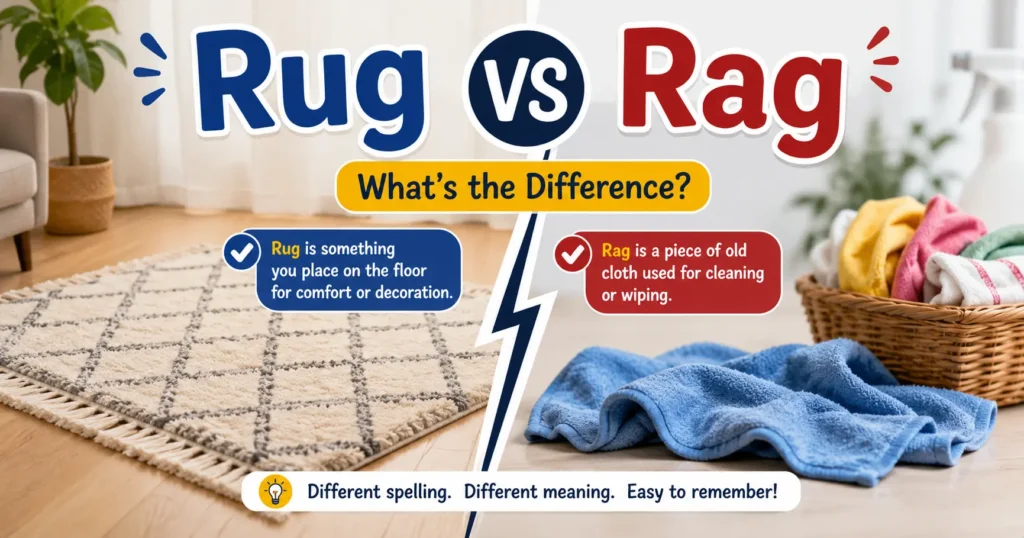
A rug is a floor covering used for decoration, warmth, or comfort. A rag is a piece of cloth, usually old or worn, used for cleaning, wiping, or polishing. The core difference is purpose. Rugs go on floors to add style and comfort. Rags handle chores and messes. These two words look similar and rhyme, but they mean very different things in English.
If you have ever written “rag” when you meant “rug,” you are not alone. These two words look almost the same, they rhyme perfectly, and both involve fabric. It is easy to mix them up, especially for ESL learners who are still building their English vocabulary.
But here is the good news. Once you understand the difference between rug and rag, you will never confuse them again. In this guide, you will learn what each word means, how to pronounce them correctly, how to use them in real sentences, and how they appear in common English idioms. By the end, you will feel completely confident using both words.
What Is the Difference Between a Rug and a Rag?
A rug is a thick, woven floor covering. People place rugs in living rooms, bedrooms, hallways, and entryways to add warmth, comfort, and style. Rugs can be decorative, functional, or both. They come in many sizes, colors, and materials.
A rag is a piece of cloth that is old, worn, or torn. People use rags to clean surfaces, wipe up spills, polish shoes, or dust furniture. Rags are usually not meant to look good. They are meant to get the job done.
The key difference is purpose and placement. A rug lives on the floor and improves a room. A rag lives in your cleaning kit and handles dirty work.
Here is a quick comparison to make this even clearer:
| Feature | Rug | Rag |
| Main purpose | Decoration and comfort | Cleaning and polishing |
| Where it is used | On the floor | In the hand or cleaning bucket |
| Typical condition | New, well-made, intentional | Old, worn, or torn |
| Common materials | Wool, cotton, jute, synthetic fiber | Cotton, linen, microfiber, old clothing |
| Example | A Persian rug in the living room | A cotton rag to wipe the counter |
Both are made of textile material, but that is where the similarity ends. One is woven fabric for your floor. The other is repurposed fabric for your chores.
How Do You Pronounce Rug and Rag?
This is one of the most important sections for ESL learners. The spelling difference between rug and rag is just one letter, but the pronunciation difference is clear once you know what to listen for.
Rug is pronounced /rʌɡ/. The vowel sounds like the “u” in “cup,” “bug,” “mug,” and “hug.” It is a short, round vowel sound in the back of your mouth.
Rag is pronounced /ræɡ/. The vowel sounds like the “a” in “bag,” “flag,” “tag,” and “cat.” It is a short, flat vowel sound that sits more at the front of your mouth.
Here is a simple rhyming word table to help you remember:
| Word | IPA | Rhymes With |
| Rug | /rʌɡ/ | bug, mug, hug, jug, slug |
| Rag | /ræɡ/ | bag, flag, tag, drag, wag |
If you can say “bug” and “bag” without confusion, you can say “rug” and “rag” without confusion. Practice those two vowel sounds and the difference will stick very quickly.
Native English speakers almost never mix these two words when speaking because the vowel sounds are noticeably different. For non-native speakers, practicing the /ʌ/ and /æ/ sounds out loud a few times is all it takes.
Where Do the Words Rug and Rag Come From?
The Origin of the Word Rug
The word “rug” comes from Middle English and is closely connected to Old Scandinavian and Old English roots. Linguists trace it to a word meaning “shaggy tuft” or “coarse cloth.” Over time, the meaning shifted to describe floor coverings made from thick, woven material. By the 19th century, “rug” had taken on its modern meaning as a decorative floor covering, separate from the broader word “carpet.”
The Origin of the Word Rag
The word “rag” also comes from Middle English, from the word “ragge,” which referred to worn or torn fabric. The image behind the word has always been the same. A rag is cloth that has been used up, frayed, or deliberately cut into strips for cleaning or wiping. The Proto-Germanic and Old Norse connections to this word reinforce the idea of something rough and worn.
By the time modern English was established, rug and rag had completely separate meanings even though they once came from neighboring corners of the same Old English textile vocabulary.
How to Use Rug and Rag in a Sentence
Seeing both words used in real sentences is the fastest way to lock in the difference. Here are original example sentences for each word.
Rug in a Sentence
- She bought a beautiful Persian rug to decorate the living room floor.
- The children sat on the soft cotton rug and played board games all afternoon.
- Please wipe your shoes on the door rug before you come inside.
- The area rug added a warm, cozy feeling to the bedroom.
- He tripped on the edge of the woven rug near the fireplace.
- The jute rug in the hallway was both eco-friendly and stylish.
- She decided to sweep the problem under the rug instead of dealing with it. (idiom)
- The accent rug tied the whole dining room together.
Rag in a Sentence
- He grabbed a cotton rag from the bucket and started polishing the car.
- She used an old T-shirt as an absorbent cloth to wipe up the spill.
- The mechanic’s hands were covered in oil, and he reached for a clean rag.
- Mom cut up worn-out towels into smaller rags for the cleaning kit.
- The microfiber rag was perfect for dusting the laptop screen without scratching it.
- The child’s rag doll had been loved so much that its fabric scraps were soft and faded.
- He started from rags and built a company worth millions. (idiom)
- The old painting rags were soaked in linseed oil and stored carefully.
Notice how “rug” always appears in a floor-related or decorative context, while “rag” appears in cleaning, polishing, or crafting situations. That pattern will guide you every time.
What Is a Rag Rug?
Here is where things get interesting. A rag rug is a real thing, and it is exactly what it sounds like.
According to Merriam-Webster, a rag rug is “a hand-woven or machine-woven rug made with a heavy cotton warp and a filling of rags torn into strips.” In other words, a rag rug is a floor covering made entirely from repurposed fabric and old clothing. It is a rug built from rags.
Rag rugs have a long history in folk and craft traditions around the world. They were originally made to reuse worn-out clothing and fabric scraps, turning what would otherwise be waste into a beautiful, durable floor covering. Today, rag rugs are experiencing a strong revival as part of the eco-friendly and DIY home decor movement in 2024 and 2025.
Here is how a basic rag rug is made:
- Gather old fabric, worn clothing, or recycled textile material in your chosen colors.
- Cut or tear the fabric into long, even strips of equal width.
- Braid, weave, or hook the strips together using a loom or simple braiding technique.
The result is a colorful, handmade floor covering that is both functional and sustainable. So while a rug and a rag are two different things, a rag rug proves that one can literally become the other.
Common Idioms That Use Rug and Rag
Both words appear in well-known English idioms. Understanding these expressions will help you sound more natural in everyday conversation and written English.
Rug Idioms:
- Sweep under the rug means to hide a problem or pretend it does not exist. Example: “The manager tried to sweep the mistake under the rug, but the team had already noticed it.”
- Pull the rug out from under someone means to suddenly take away support or stability. Example: “The company pulled the rug out from under its workers by cancelling bonuses without warning.”
- On the rug is an informal phrase meaning to be called in for a reprimand. Example: “The student was called on the rug for skipping class three days in a row.”
Rag Idioms:
- Rags to riches describes the story of someone who rises from poverty to great wealth. Example: “His rags to riches story inspired thousands of readers around the world.”
- Dressed in rags means wearing very worn, tattered, or torn clothing. Example: “The character in the fairy tale was dressed in rags before the transformation.”
- In rags means in a state of extreme poverty or very poor condition. Example: “The survivors arrived in rags, exhausted from the long journey.”
Knowing these idioms will help you recognize figurative language when you read English books, news articles, and conversations.
Rug vs Rag at a Glance
Here is a final side-by-side comparison table you can use as a quick reference whenever you are unsure which word to use.
| Category | Rug | Rag |
| Definition | A woven floor covering | A worn or torn piece of cloth |
| Primary use | Decoration and comfort | Cleaning, wiping, polishing |
| Placement | On the floor | In the hand or cleaning area |
| Condition | New, decorative, well-made | Old, worn, repurposed |
| Common types | Area rug, accent rug, Persian rug, door mat | Cotton rag, microfiber cloth, polishing rag |
| Idiom example | Sweep under the rug | Rags to riches |
| IPA pronunciation | /rʌɡ/ | /ræɡ/ |
The simplest rule to remember: if it goes on the floor, it is a rug. If it goes in your hand for cleaning, it is a rag.
Final Thought
Understanding the difference between rug and rag is a small but important step in building strong English vocabulary. Both words appear in everyday speech, in writing, and in popular English idioms. Once you know the purpose, pronunciation, and usage of each word, you will never mix them up again.
The key takeaway is simple. A rug adds beauty and warmth to a room. A rag gets your hands dirty so your surfaces stay clean. One is placed with care. The other is used with purpose.
If this guide helped you, there are plenty more word pair comparisons waiting for you on correctenglish.org. Explore articles like Mat vs Rug, Cloth vs Fabric, and Similar-Sounding Words in English to keep sharpening your vocabulary skills. The more word pairs you master, the more confident your English writing and speaking will become.