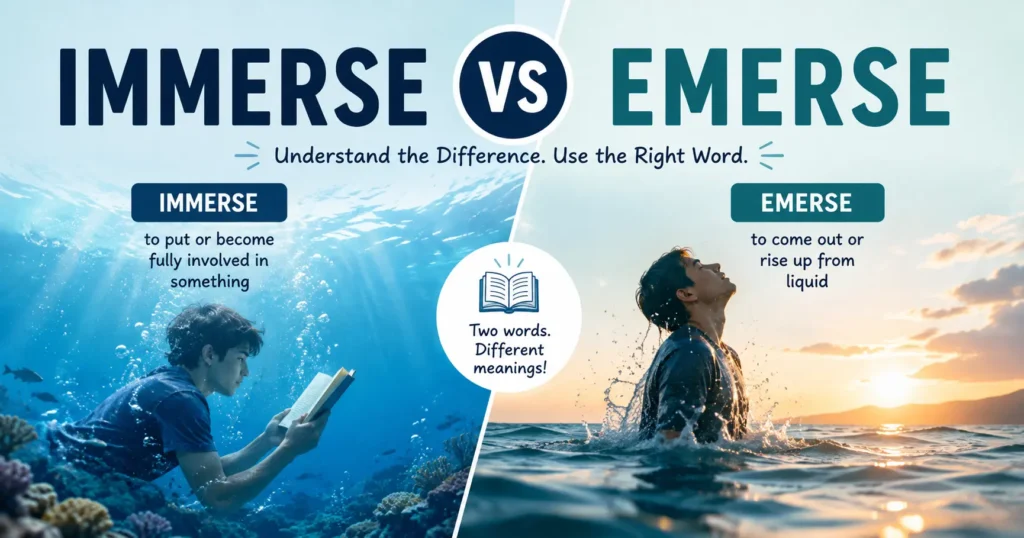
Immerse means to submerge something completely in a liquid or to engage deeply in an activity. Emerse means to rise above the surface of a liquid. The two words are antonyms. They come from opposite Latin roots. While “immerse” is very common in everyday English, “emerse” is mostly used in botany and science. Knowing the difference helps you choose the correct word every time.
Have you ever read a sentence and stopped to wonder: should I write immerse or emerse? These two words look almost the same, but they mean the opposite of each other. That is what makes them so confusing.
In this guide, you will get a clear definition of both words, a side-by-side comparison, and real example sentences. By the end, you will know exactly which word to use and why. Let us start with the word most people already know: immerse.
What Does “Immerse” Mean?
Immerse is a verb. It means to put something completely under the surface of a liquid. It also means to become deeply involved in something, like a task or an experience.
According to Merriam-Webster, immerse means “to plunge into something that surrounds or covers.” The Cambridge Dictionary adds that it also means “to become completely involved in something.”
Here are three clear ways to use this word:
- Physical use: She immersed the cloth in cold water to remove the stain.
- Learning use: He immersed himself in the Spanish language for six months.
- Tech use: The headset lets players fully immerse themselves in a virtual world.
The word covers total involvement, whether that is in water, in a culture, or in an activity. That sense of being completely “in” something is the core idea behind immerse.
What Does “Emerse” Mean?
Emerse is a verb and an adjective. It means to rise above the surface of a liquid. It describes something that comes up and out of a liquid environment.
You may also see the spelling emersed. Both forms are correct. Emerse is the direct antonym of immerse. Where immerse means going in, emerse means coming out.
This word is mostly used in two areas:
- Botany: Emersed aquatic plants are plants with roots underwater and leaves that grow above the water surface.
- Astronomy: Emersion is the moment when a star or planet reappears after an eclipse.
In everyday writing, you will rarely need to use emerse. It belongs mainly to science, botany, and astronomy texts. If you are writing general content and want to say something “came out of water,” the word emerge is almost always the better choice.
Immerse vs Emerse: What Is the Real Difference?
This is the key section. Here is the direct comparison you need.
| Feature | Immerse | Emerse |
| Core meaning | To submerge fully in a liquid OR engage deeply | To rise above a liquid surface |
| Direction | Downward and inward | Upward and outward |
| Everyday frequency | Very common | Rare |
| Main domains | General English, learning, VR, baptism | Botany, astronomy |
| Part of speech | Verb | Verb or adjective |
| Latin root | immergere (to plunge in) | emergere (to rise out) |
| Relationship | Opposite of emerse | Opposite of immerse |
The Latin prefix is the fastest way to remember the difference. The prefix im- means “into.” The prefix e- or ex- means “out of.” So:
Immerse = go into the water. Emerse = come out of the water.
That one rule covers every usage of both words. If you remember the prefixes, you will never confuse these two words again.
How to Use “Immerse” in a Sentence
Seeing a word in action is the best way to understand it. Here are five example sentences showing correct use of immerse:
- The chef immersed the chicken in a flavorful marinade overnight.
- To pass her Spanish exam, she immersed herself in the language for three months.
- The new VR headset lets users immerse themselves in a fully digital environment.
- The doctor recommended immersion therapy to help the patient overcome their fear of water.
- During baptism, the priest immersed the person fully in the water as part of the ceremony.
Notice how each sentence involves going completely “into” something. That is always the sign you need the word immerse.dictionary.
How to Use “Emerse” in a Sentence
Emerse appears far less often in everyday writing. Here are three correct examples:
- The lily pads emersed above the surface of the pond, reaching up toward the sunlight.
- After the eclipse ended, the planet emersed from the shadow of the moon.
- Emersed aquatic plants like cattails grow with their roots anchored below water and their leaves above it.
Important usage warning: If you are writing a general article or blog post and want to say something “came out of the water,” use emerge, not emerse. Emerse is a specialist word. Using it in casual writing can confuse your readers.
Where Are These Words Actually Used?
Both words have very specific homes in real-world writing. Knowing those homes helps you use each word with confidence.
Where “Immerse” Is Used
Immerse shows up in many areas of everyday life:
- Language immersion programs: Schools and apps like language courses use “immersive learning” to describe total involvement in a new language.
- Virtual reality and technology: VR and AR developers describe their products as “immersive experiences.”
- Psychology and therapy: Immersion therapy, also called exposure therapy, involves deeply engaging with a fear in a controlled setting.
- Religion: Baptism by immersion is a practice in many Christian traditions where a person is fully submerged in water.
Where “Emerse” Is Used
Emerse belongs mostly to science and specialist fields:
- Botany: Emersed aquatic vegetation includes plants like cattails, water lilies, and bulrushes. These plants grow in shallow water with their roots below and their leaves above the surface.
- Astronomy: Emersion refers to the reappearance of a celestial body, such as a star or planet, after it passes behind another object or exits an eclipse.
The Latin Roots That Explain Everything
The history of both words comes from Latin. Once you understand the roots, the meaning of each word becomes obvious.
- Immerse comes from the Latin word immergere, which means “to plunge in.” It entered the English language around the 15th century.
- Emerse comes from the Latin word emergere, which means “to rise.” It appeared in English in the late 17th century.
The prefixes tell the whole story. Im- means “into.” E- or ex- means “out of.” That is the entire rule. Use immerse when something goes in. Use emerse when something comes out.
Memory rule: Immerse = into. Emerse = exit.
Final Thoughts
The difference between immerse and emerse is simple once you know the Latin roots. Immerse means to go in. Emerse means to come out. They are antonyms, not synonyms.
In everyday writing, you will almost always use immerse. Whether you are talking about language immersion, virtual reality, or submerging something in a liquid, this is your go-to word. Use emerse only when you are writing about botany, astronomy, or another science field.
When in doubt, remember the prefix rule: im- means into, and e- means out. That rule will save you every time.
Ready to sharpen your vocabulary further? Explore our guides on other commonly confused English words and build the word confidence you need for clear, correct writing.