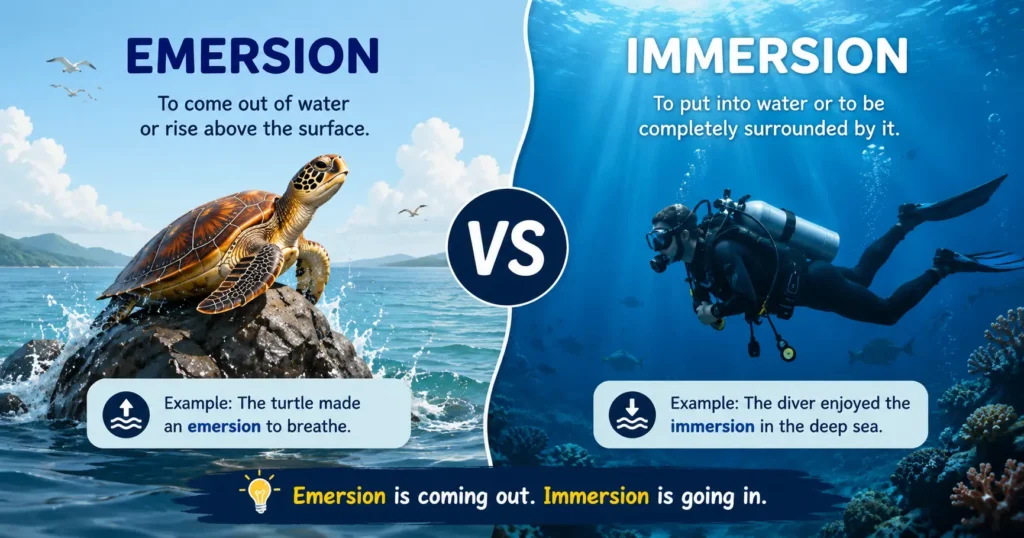
Immersion means entering deeply into something, such as submerging in water, fully engaging in a task, or learning through a language immersion program. Emersion is the opposite: it means coming out of something, like rising from water or a celestial body reappearing after an eclipse. Both are real English words, but immersion is used every day while emersion is mostly scientific and technical. The memory trick: I = Into, E = Exit.
If you typed “emersion” and someone told you it was a spelling mistake, they were wrong. Emersion is a real, legitimate English word with roots going back to the 1600s. But it does not mean the same thing as immersion. In fact, these two words are opposites. This guide will show you exactly what each word means, how to use both correctly in a sentence, and a simple trick so you never mix them up again.
What Is the Difference Between Emersion and Immersion?
Here is the short answer: immersion means going into something, and emersion means coming out of something. They are antonyms, which means they have opposite meanings.
Think of a diver. The moment they plunge into the ocean, that is immersion. The moment their head breaks the surface and they rise up out of the water, that is emersion.
| Feature | Immersion | Emersion |
| Core meaning | Going into / being fully inside | Coming out of / rising above |
| Direction | Inward or downward | Outward or upward |
| Everyday usage | Very common | Rare, mostly scientific |
| Root verb | Immerse | Emerge |
| Typical contexts | Water, education, technology, culture | Astronomy, marine biology, water |
One letter separates these two words, but that one letter flips the entire meaning. Keep this in mind as you read through the definitions below.
What Does Immersion Mean?
Immersion is the act of plunging something or someone completely into a substance, experience, or environment. According to Cambridge Dictionary, immersion means “the fact of becoming completely involved in something” or “the process of learning a language by using nothing else but that language.”
Vocabulary.com defines immersion as “the act of dipping something in a substance, completely covering it,” noting that it can be physical like plunging your body into water, or mental like becoming totally absorbed in a project.
Physical Immersion
Physical immersion happens when a person or object is placed fully under a liquid. Baptism by immersion is one of the oldest uses of this word. In religious traditions, a person is submerged completely in water as a spiritual act. An immersion blender gets its name the same way: the blending head is immersed directly into the food.
Immersion in Education
Language immersion programs are one of the most popular uses of this word today. In an immersion program, students learn a new language by being surrounded by it at all times. They hear it, speak it, read it, and write it without switching back to their first language.
Immersive learning is growing fast in schools and online platforms. Research in educational psychology shows that students in immersion programs develop stronger language skills and cultural understanding than those using traditional methods.
Immersion in Technology
Virtual reality and augmented reality experiences are described as immersive environments because they surround the user completely. In gaming, immersive design means the player feels pulled into the world of the game. The idea is the same: complete engagement, total absorption, deep cognitive focus.
What Does Emersion Mean?
Yes, emersion is a real word. It is not a misspelling of immersion. Merriam-Webster defines emersion simply as “an act of emerging: emergence.”
Vocabulary.com explains it this way: “Emersion is when something that’s been out of sight appears or emerges. It is especially common when talking about something or someone rising from the water after being submerged.”
The word comes from the Latin root emergere, meaning to rise out. Emersion first appeared in English texts in the 1630s, almost entirely in astronomical writing.
Emersion in Everyday Language
In plain English, emersion describes the act of coming out of something. A swimmer surfacing for air experiences emersion. A submarine rising to the surface is in a state of emersion. Any object or person that was hidden, submerged, or concealed and then appears again can be described as undergoing emersion.
Emersion in Astronomy
This is where emersion is most commonly used by scientists and researchers. In astronomy, emersion refers to the reappearance of a celestial body after it has been hidden during an eclipse, occultation, or transit.
Dictionary.com defines this sense as “the emergence of a heavenly body from an eclipse, an occultation, or a transit.” The opposite event, when a celestial body disappears behind another, is called immersion, also known as ingress. When it reappears, that is emersion, also known as egress.
For example: astronomers track the emersion of a moon from behind a planet to calculate its orbital position precisely.
Emersion in Marine Biology
In the intertidal zone, organisms such as barnacles and sea anemones experience regular cycles of submersion and emersion. During low tide, the water pulls back and the organisms are exposed to air. This exposed state is called emersion. During high tide, they return to a submerged state. Marine biology researchers study how these organisms survive extended periods of tidal emersion.
Etymology: Where Do These Words Come From?
Understanding the roots of these two words makes the difference crystal clear.
| Word | Latin Root | Root Meaning | First Used in English |
| Immersion | immersionem / immergere | To plunge into | 15th century |
| Emersion | emergere | To rise out of | 1630s (astronomy) |
Immersion entered English in the 1400s through religious and scientific writing about baptism and physical submersion. Emersion followed about two centuries later, appearing first in astronomy texts to describe celestial reappearance.
The prefix tells the whole story. Im comes from in, meaning into. E comes from ex, meaning out of. These prefixes are the same ones you see in words like import and export, or immigration and emigration.
How to Use Emersion and Immersion Correctly
This section shows you real sentence examples and flags the most common mistake writers make.
Example Sentences Using Immersion
- The immersion of the fabric in hot water caused the colors to bleed.
- She signed up for a full immersion program to learn Mandarin in three months.
- The child’s complete immersion in the video game lasted for hours.
- Baptism by immersion is practiced in several Christian denominations.
- The VR headset created total immersion in a simulated underwater world.
Example Sentences Using Emersion
- The emersion of the diver from the deep water was greeted with cheers.
- Astronomers recorded the exact time of the moon’s emersion from behind Jupiter.
- After two weeks of intense study, his emersion from the library felt like surfacing for air.
- The barnacles cling to rocks during periods of tidal emersion.
- The emersion of the submarine was visible from the coastline.
Correct vs. Incorrect Usage Drill
This is the most common mistake writers make. They use immersion when describing something or someone coming out of water, when the correct word is emersion.
| Incorrect | Correct | Why |
| The diver’s immersion from the water was dramatic. | The diver’s emersion from the water was dramatic. | The diver is coming OUT, not going in. |
| We watched the star’s emersion behind the planet. | We watched the star’s immersion behind the planet. | The star is going IN (disappearing), not reappearing. |
| Her emersion in the work kept her focused for hours. | Her immersion in the work kept her focused for hours. | Deep engagement = immersion (going into something mentally). |
| The immersion of the moon after the eclipse was a beautiful sight. | The emersion of the moon after the eclipse was a beautiful sight. | The moon is coming back into view = emersion. |
The Memory Trick: How to Never Confuse These Words Again
Here is the simplest way to remember the difference forever.
I in Immersion = Into.
E in Emersion = Exit.
Picture a diver at the edge of a pool. The moment they dive in, going into the water, that is Immersion. The moment they climb out and exit the water, that is Emersion.
You can also think of it like emigration and immigration. Immigration means coming into a country. Emigration means going out and exiting a country. Emersion and immersion follow the exact same logic.
Once you see the prefix pattern, you will never mix these words up again.
Emersion and Immersion in Education
Both words actually appear in the world of educational psychology and language learning, though they describe different phases of the same process.
Immersion in education refers to a teaching method where students are surrounded by a language or subject at all times. In a Spanish immersion program, for example, all instruction happens in Spanish. Students hear it, read it, think in it, and speak it throughout the school day. The goal is total absorption, which accelerates learning and builds natural fluency.
Emersion in an educational context describes what happens after the immersion phase ends. When students complete an immersion program and return to their regular environment, they go through a phase of reflecting on and integrating everything they learned. Some educational researchers use the term emersion to describe this post-immersion reflective stage, where students process their experience and find ways to apply their new skills in everyday life.
So in this context, immersion is the deep dive, and emersion is the surfacing.
Quick Reference: Emersion vs Immersion Side by Side
| Category | Immersion | Emersion |
| General meaning | Entering deeply into a liquid, activity, or experience | Coming out of or rising from a liquid or hidden state |
| Astronomy | Disappearance of a celestial body (ingress) | Reappearance of a celestial body (egress) |
| Marine biology | Organism submerged in water | Organism exposed during low tide |
| Education | Language immersion programs, immersive learning | Post-program reflection and integration phase |
| Technology | VR/AR immersive environments, immersion blender | Not commonly used |
| Religion | Baptism by immersion (full submersion) | Not commonly used |
| Root verb | Immerse | Emerge |
| Frequency | Very common in everyday writing | Rare, mostly technical or scientific |
Final Thoughts
Emersion and immersion are genuine antonyms. Immersion pulls you in. Emersion brings you out.
Most people will use immersion on a daily basis in conversations about learning, technology, cooking, and culture. Emersion will show up mostly in science texts, astronomy articles, and marine biology research. But knowing both words, and knowing exactly when to use each one, makes you a more precise and confident writer.
When in doubt, go back to the prefix: I = Into, E = Exit. That single trick will keep you on the right track every time.