Data is plural in form, from the Latin word datum. In modern English it takes either a singular or plural verb. Use “data is” when you mean a body of information, which is common in everyday, business, and tech writing. Use “data are” when you mean separate facts or measurements, which is common in scientific and academic writing. Follow your style guide and stay consistent within one document.
You type “the data” and then stop. Should the next word be “is” or “are”? So, is data plural or singular? The short answer is that it can be both. This guide gives you a simple rule for each case. You will also see what APA, AP, and other style guides say, and how to avoid the problem when you want to.
Is Data Plural or Singular?
Data is plural in form, but modern English accepts it as singular or plural. Merriam-Webster treats both as standard. Use a singular verb when data means a body of information (“the data is clear”). Use a plural verb when it means separate facts (“the data are inconsistent”).
Here is a quick guide to data singular or plural choices by situation.
| Situation | Best choice | Example |
| Everyday writing | data is | The data is on my phone. |
| Business or tech writing | data is | The data is stored on a secure server. |
| News for a general audience | data is | The data is clear. |
| Academic paper or lab report | data are | The data are reliable. |
| A style guide that requires plural | data are | These data were collected last spring. |
If you only need a fast answer, use this table. The rest of the guide explains why.
Why Is Data a Plural Word? (Data vs Datum)
Data comes from the Latin plural of datum. Datum means “something given.” English kept data and mostly dropped datum.
The singular of data is still datum, but almost no one uses it today. People say “data point” or “piece of data” when they mean one item. Britannica’s dictionary notes that data is technically plural, yet writers use it with both singular and plural verbs.
Over time, many writers began to treat data like the word “information.” That is why “the data is” sounds natural to so many people.
Data Is vs Data Are: When to Use Each
The choice comes down to how you think about the word. Ask one question: do I mean one big pile of information, or a list of separate facts?
Use “Data Is” (Singular Mass Noun)
A mass noun names something you do not count one by one. “Water,” “advice,” and “information” are mass nouns. Data works this way when it means a whole body of information.
A mass noun takes a singular verb. This is basic subject-verb agreement. You can read more about it in our guide on countable and uncountable nouns in “is there any” vs “are there any“.
Here are some examples:
- The data is ready for review.
- The data has been saved.
- Is the data correct?
Some writers ask, “Is data countable or uncountable?” In this use, it is uncountable. You say “much data,” not “many data.”
Use “Data Are” (Plural Noun)
Use “data are” when you mean many separate facts, numbers, or measurements. This is the older, traditional use. It is the Latin plural at work.
Here are some examples:
- The data are consistent across all three tests.
- These data were collected from 40 schools.
- The data show a small rise each year.
Merriam-Webster says both uses are standard. It also says the plural use does not pair well with exact numbers. So “100 data” sounds odd. Write “100 data points” instead.
Some people also call data a collective noun. That means one word names a group. With a collective noun, you can choose a singular verb for the group as a unit, or a plural verb for the members. Data works in a similar way.
What Do APA, AP, and Chicago Say About Data?

Style guides do not agree. Here is what the main ones say.
| Style guide | What it says |
| APA Publication Manual (7th edition) | Treat data as plural: “data are.” |
| AP Stylebook | Use a singular verb for a general audience. Use plural in scientific and academic writing. |
| Chicago Manual of Style (18th edition) | More relaxed than APA. Check the current edition. |
| Merriam-Webster | Both singular and plural uses are standard. |
| The Guardian | Use a singular verb, like “agenda.” |
| Microsoft Manual of Style | Use a singular verb. |
| The Wall Street Journal | Allowed both singular and plural in its house style in July 2012. |
So the APA data plural rule is strict. The AP style data rule depends on who reads your work. If you write for a class, a journal, or a company, ask which guide they use. Then follow it.
Is Usage Changing?
Yes. The singular is now very common. A linguist checked a news database and found “data is” far more likely than “data are.” Vice reported that “is” showed up more than seven times as often as “are.” A style site that used Google Ngram Viewer says “data is” passed “data are” in books around 1985.
Even major papers mix them. The New York Times has printed both forms in a single day.
Which Should You Use in Your Writing?
Match your reader. Here is a simple rule for each type of writing:
- Academic writing and formal writing: Use “data are.” Scientists care about this more than most readers.
- Journalism and general audience writing: Use “data is.” It sounds natural.
- Business and tech writing: Use “data is.” It reads like the word “information.”
- Your style guide says something else: Follow the style guide.
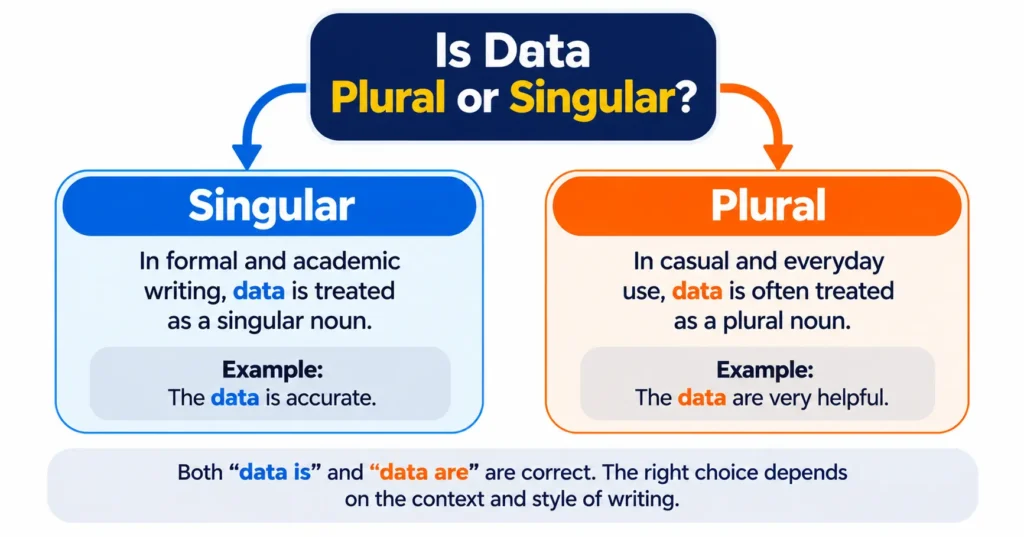
If no one gives you a rule, pick one form. Then stay consistent through the whole document. Switching back and forth is the real mistake.
Matching Verbs, Pronouns, and Modifiers With Data
Once you pick a form, match everything else to it. This includes the verb, the pronoun, and the small words before the noun.
| Singular use | Plural use | |
| Verb | The data is clear. | The data are clear. |
| Past tense | The data was late. | The data were late. |
| Pronoun | It is accurate. | They are accurate. |
| This or these | this data | these data |
| Amount word | much data, little data | many data points, few data points |
That table answers two common questions. For “data was or were,” use “was” for one body of information. Use “were” for separate facts. For “this data or these data,” use “this” with the singular and “these” with the plural.
The word choice for amounts works like the rule in our post on less than vs fewer than. A mass noun takes “less” or “much.” A plural noun takes “fewer” or “many.”
Do not mix the two in one sentence. “This data are wrong” mixes a singular word with a plural verb. Choose “this data is wrong” or “these data are wrong.”
Common Mistakes With Data
Here are the errors to watch for.
- Writing “datas.” This is not a word. Data already works as a plural or a mass noun. Write “datasets” or “data points” when you mean more than one.
- Mixing forms in one paper. Wrong: The data is strong, and they show a clear trend. Right: The data is strong, and it shows a clear trend.
- Using a number with data. Wrong: We collected 100 data. Right: We collected 100 data points.
- Using “datum” in casual writing. It is correct but sounds stiff. “Data point” is more common.
How Can You Avoid the Debate?
You can skip the question by changing the sentence. Swap “data” for a clearer noun. Try “data points,” “results,” “figures,” “records,” or “information.”
Here are two before and after examples.
- Before: The data show a rise in sales.
- After: The sales figures rose this year.
- Before: The data is not complete.
- After: The records are not complete.
Grammar writer Mignon Fogarty has said a plural “data” can sound awkward to general readers, so a rewrite is often the best fix. It keeps the sentence natural for every audience.
Quick Recap: The Rule in Plain Words
Here is the easy way to remember it: one pile means “is.” Many facts mean “are.”
- Data is plural in form. It comes from the Latin plural datum.
- Both “data is” and “data are” are accepted.
- Academic writing and APA prefer the plural. AP and everyday writing often use the singular.
- Pick one form and use it the same way through your whole document.
Keep Building Your Grammar Skills
Now you know when to use “data is” and when to use “data are.” Next time you write a report, an essay, or an email, pick a form and stick with it. If you want to keep learning, browse our full collection of grammar guides. You can also try CorrectEnglish on your next draft for a second check.
Frequently Asked Questions
Should I say “data is” or “data are”?
Both are correct. Use “data is” in general, business, and tech writing. Use “data are” in academic and scientific writing or when your style guide requires it. Stay consistent within one document.
What is the singular of data?
The singular is datum, but it is rare in modern English. Most writers say “data point” or “piece of data” for a single item.
Is it “the data was” or “the data were”?
Use “was” when data means one body of information. Use “were” when data means separate facts, especially in formal or scientific writing. Pick one and keep it consistent.
Is “datas” a word?
No. Data is already a plural-form noun and also works as a mass noun. Use “datasets” or “data points” to talk about more than one group or item.
What do APA and AP style say about data?
APA 7 treats data as plural. AP uses a singular verb for general audiences and plural in scientific writing. Check the current manual of the style you follow.
Is data countable or uncountable?
It depends on use. As a mass noun, like “information,” data is uncountable and takes “much.” As a plural noun, it takes “many” and a plural verb.