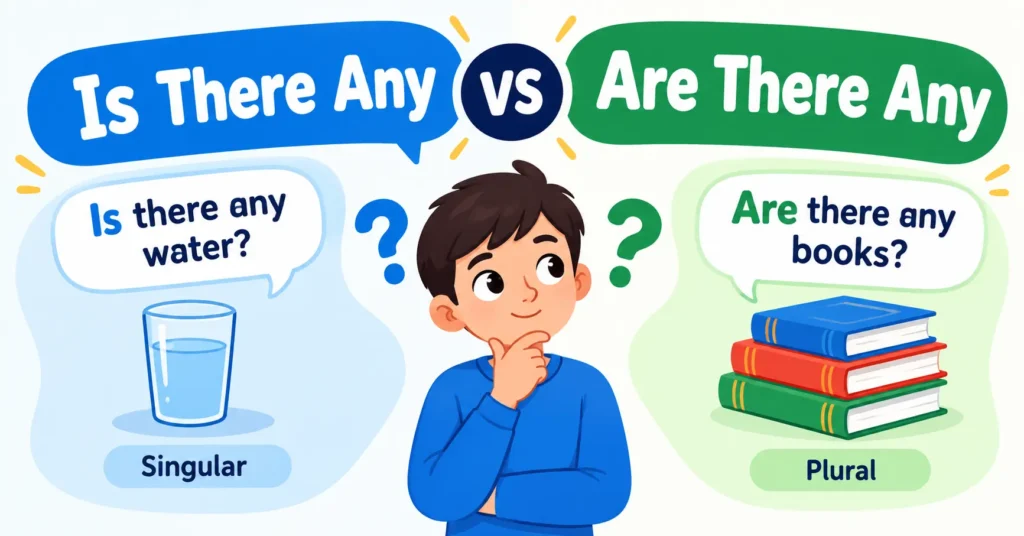
“Is there any” and “are there any” follow a simple English grammar rule based on noun type. Use “is there any” with singular countable nouns and uncountable nouns. Use “are there any” with plural countable nouns. The correct choice depends on the noun that follows, not on the word “any” itself. Once you know your noun type, you will always pick the right form.
What Is the Difference Between “Is There Any” and “Are There Any”?
Many English learners ask this question. Both forms look similar, but they follow a clear grammar rule based on subject-verb agreement.
The verb you choose, either “is” or “are,” must agree with the noun that follows it. That noun is what controls your choice. The word “any” does not change the rule.
Here is the simple version:
- “Is there any” goes with singular countable nouns and uncountable nouns.
- “Are there any” goes with plural countable nouns.
Think of it this way. Before you write the question, look at the noun. Ask yourself: is this noun singular, plural, or uncountable? Your answer tells you which verb to use. This noun-first approach removes the confusion at its root.
When to Use “Is There Any”
“Is there any” is correct in two situations. Both situations involve a noun that is grammatically singular, either a singular countable noun or an uncountable noun. The verb “is” matches singular nouns in English, so “is there any” is the natural fit.
Is There Any with Singular Countable Nouns
A singular countable noun names one item that can be counted. When the noun is singular and countable, use “is there any.”
Here are clear examples:
- Is there any apple left in the bowl?
- Is there any ticket available for tonight?
- Is there any seat near the window?
Each noun here, apple, ticket, and seat, is singular. One item, one verb: “is.”
Is There Any with Uncountable Nouns
Uncountable nouns name things that cannot be counted as individual units. Words like water, information, advice, furniture, money, and equipment are all uncountable nouns. These nouns are always grammatically singular in English, even when the amount feels large.
Because uncountable nouns are singular, you always use “is there any” with them.
Here are clear examples:
- Is there any water in the glass?
- Is there any information about the meeting?
- Is there any advice you can give me?
- Is there any furniture in the new apartment?
- Is there any money left in the account?
This is the part that confuses most English learners. Words like “information” and “advice” feel like they could be plural, but they are not. They are uncountable, so they always take “is.”
When to Use “Are There Any”
“Are there any” is correct when the noun is plural and countable. Plural countable nouns name more than one item that can be counted. The verb “are” matches plural nouns in English.
Here are clear examples:
- Are there any books on the shelf?
- Are there any students in the classroom?
- Are there any questions after the lesson?
- Are there any tickets left for the concert?
- Are there any problems with the report?
Notice that each noun here is plural: books, students, questions, tickets, problems. More than one item, plural verb: “are.”
One rare exception: You can use “are there any” with an uncountable noun when you name a specific unit. For example: “Are there any glasses of water left?” Here, “glasses” is the plural countable noun, not “water.” The verb “are” agrees with “glasses,” not with “water.” This exception is rare, but it is worth knowing.
Quick Reference: “Is There Any” vs “Are There Any” at a Glance
Use this table to make the right choice every time.
| Noun Type | Correct Form | Example Sentence |
| Singular countable noun | Is there any | Is there any chair near the door? |
| Uncountable noun | Is there any | Is there any milk in the fridge? |
| Plural countable noun | Are there any | Are there any chairs in the room? |
| Plural unit of uncountable noun | Are there any | Are there any cups of coffee ready? |
When you are unsure, stop and identify the noun first. Then match the verb to the noun type. This one step solves the problem every time.
The Most Common Mistake: “Is There Any Questions?”
Is “is there any questions” correct? No, it is not. This is the single most common grammar mistake in this area of English.
“Questions” is a plural countable noun. Plural countable nouns require the plural verb “are.” So the correct form is always:
- Wrong: Is there any questions after the presentation?
- Right: Are there any questions after the presentation?
This mistake happens because speakers sometimes focus on the word “any” instead of the word “questions.” They hear “is there any…” and continue without checking the noun. Once you train yourself to check the noun first, this error disappears.
Here are more examples of the same type of mistake, corrected:
- Wrong: Is there any students in the hall?
- Right: Are there any students in the hall?
- Wrong: Is there any problems with the file?
- Right: Are there any problems with the file?
- Wrong: Is there any seats available?
- Right: Are there any seats available?
In each case, the noun is plural and countable. That means “are” is always the correct verb, not “is.” Grammar checker tools like ProWritingAid and Grammarly will flag “is there any questions” as an error automatically. Now you know exactly why.
Edge Cases Worth Knowing
Most sentences follow the core rule without any trouble. However, a few situations can still cause confusion.
Collective nouns name a group as one unit. Words like team, staff, committee, and crew are collective nouns. In American English, collective nouns are treated as singular, so you use “is there any team available?” In British English, collective nouns can sometimes be treated as plural. When in doubt in formal writing, treat collective nouns as singular.
Noun phrases with uncountable nouns can sometimes feel plural. For example: “Is there any clean water left?” Even with the adjective “clean” added, the uncountable noun “water” stays singular. The rule does not change based on adjectives.
Informal speech is a different story. In casual conversation, you may sometimes hear native speakers say “is there any questions?” This is a common spoken error, not a grammar rule. In writing, especially in academic or professional contexts, always follow the standard subject-verb agreement rule.
Final Thoughts
The grammar rule for “is there any vs are there any” comes down to one simple habit: check the noun first. If the noun is singular or uncountable, use “is there any.” If the noun is plural and countable, use “are there any.” This noun-first approach works for every sentence.
Here is a quick recap of the key points:
- Singular countable nouns and uncountable nouns use “is there any”
- Plural countable nouns use “are there any”
- “Is there any questions?” is always wrong because “questions” is plural
- The word “any” does not determine the verb choice, the noun does
Good English grammar is built on small, clear rules like this one. Once you understand subject-verb agreement and the difference between countable and uncountable nouns, most of these questions answer themselves.
Want to keep building your grammar skills? Read our guides on There Is vs There Are, Countable vs Uncountable Nouns, and Some vs Any to strengthen your understanding even further. Each guide follows the same clear, example-first approach so you can learn and apply the rules right away.