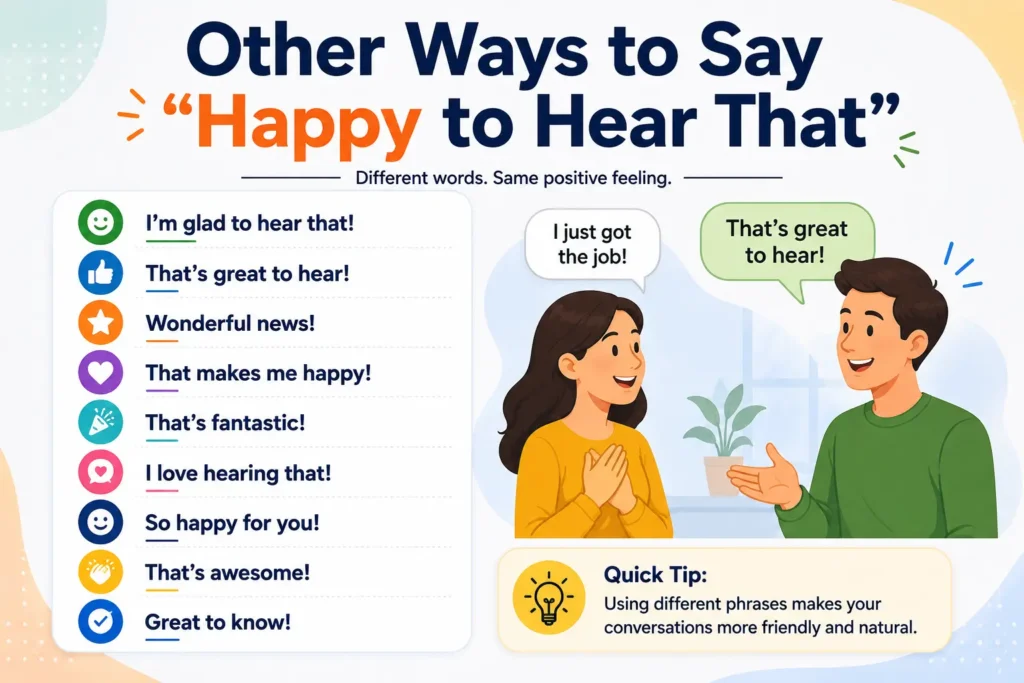
“Happy to hear that” is one of the most common phrases in everyday English. But if you use it in every email, message, or reply, it starts to sound flat and repetitive. Sometimes it just does not feel right for the moment. Maybe you need something more formal for a business email. Or maybe you want something warmer and more personal for a friend’s good news.
Other ways to say “happy to hear that” include phrases like “I am pleased to hear that,” “that is wonderful news,” “so glad to hear that,” and “that made my day.” The best choice depends on your relationship with the reader and how formal the setting is.
This guide gives you 25+ ready-to-use alternatives. Each phrase comes with a formality label and a real example sentence so you can pick the right one and use it right away.
TL;DR: “Happy to hear that” is a semi-formal expression used to show a positive emotional response to good news. Other ways to say “happy to hear that” include formal options like “I am pleased to hear that” and “that is wonderful news,” warm professional choices like “that’s great to hear,” and casual alternatives like “that’s awesome” or “great news.” The best choice depends on your relationship with the reader and the formality of the setting.
What Does “Happy to Hear That” Actually Mean?
“Happy to hear that” is a semi-formal English expression. It shows pleasure or a positive emotional response when someone shares good or encouraging news with you. It sits between very formal English phrases like “I am pleased to learn this” and very casual phrases like “that’s awesome.”
According to Power Thesaurus, the closest synonyms for this phrase include “glad to hear that,” “pleased to hear that,” and “good to know.” Cambridge Dictionary confirms that “glad to hear” works equally well in both British and American English.
The phrase works well in friendly professional emails and casual personal messages. However, it can feel too plain or too repetitive in formal business letters, client proposals, and official written correspondence.
Formal Alternatives to “Happy to Hear That”
When you need a more polished tone, these formal alternatives work well in professional emails, business correspondence, and official written responses.
Each phrase below comes with a tone note and a ready-to-use example sentence.
- I am pleased to hear that
Tone: Warm and polished. Works in client emails and professional replies.
Example: “I am pleased to hear that the project has been approved.” - That is wonderful news
Tone: Sincere and professional. Good for both formal and personal contexts.
Example: “Thank you for reaching out. That is wonderful news for the entire team.” - I am delighted to learn this
Tone: Formal and expressive. Best for business emails and written correspondence.
Example: “I am delighted to learn this and look forward to next steps.” - It is gratifying to hear
Tone: Measured and formal. Suits written business updates and official replies.
Example: “It is gratifying to hear that the feedback was positive.” - That is most encouraging
Tone: Professional and thoughtful. Shows genuine interest.
Example: “That is most encouraging, and I appreciate you keeping me informed.”
More Formal Phrases for Professional Writing
- I was very happy to receive this update
Tone: Warm but formal. Works well in email replies and written business messages.
Example: “I was very happy to receive this update from your team.” - That is excellent news
Tone: Direct and positive. Appropriate for business and professional settings.
Example: “That is excellent news. We will move forward with the plan.” - I appreciate you sharing this with me
Tone: Respectful and gracious. Shows genuine appreciation.
Example: “I appreciate you sharing this with me. It means a great deal.” - This is very welcome news
Tone: Warm and formal. Suits email replies in formal workplace settings.
Example: “This is very welcome news after several weeks of hard work.” - I am glad to receive this positive update
Tone: Professional and clear. Good for project updates and client communications.
Example: “I am glad to receive this positive update from your department.”
According to Synonynms.com, “I’m pleased to hear that” and “that’s encouraging to hear” are among the most commonly used formal alternatives in professional English writing.
Quick Comparison: Formal, Semi-Formal, and Casual
Use this table to find the right phrase at a glance. Match the formality level to your setting and your relationship with the reader.
| Phrase | Formality Level | Best Use Context |
| I am pleased to hear that | Formal | Client emails, business letters |
| That is wonderful news | Formal | Professional and personal messages |
| I am delighted to learn this | Formal | Business emails, formal correspondence |
| That is most encouraging | Formal | Written professional updates |
| That’s great to hear | Semi-formal | Friendly professional emails |
| Wonderful to hear | Semi-formal | Warm workplace messages |
| So glad to hear that | Semi-formal | Personal and friendly professional |
| Really pleased to hear that | Semi-formal | Casual office emails |
| Good to know | Semi-formal | Quick replies and brief updates |
| That’s awesome | Casual | Text messages, close colleagues |
| Great news! | Casual | Casual emails and social messages |
| That made my day | Casual | Personal messages and friendly chats |
| Love hearing that | Casual | Very informal, close friends only |
According to GrammarAtlas, “I’m pleased to hear that” suits formal business emails while “wonderful to hear” works best for emotional positivity in personal messages.
Casual and Informal Alternatives for Everyday Use
These alternatives work well in text messages, personal conversations, and casual workplace chats. They are warm, natural, and easy to use in everyday English.
- That’s awesome!
Tone: Enthusiastic and casual. Great for exciting news from a close friend.
Example: “You got the job? That’s awesome!” - So happy for you!
Tone: Personal and warm. Shows genuine happiness about someone else’s good news.
Example: “You passed your exam? So happy for you!” - Great news!
Tone: Upbeat and casual. Works well in both text messages and informal emails.
Example: “Great news! I will pass this along to the rest of the group.” - That made my day
Tone: Warm and personal. Shows real emotional impact.
Example: “Hearing that you are feeling better really made my day.” - Love hearing that!
Tone: Very informal and enthusiastic. For close friends and family only.
Example: “Love hearing that everything went well on your trip!”
Very Informal Alternatives for Close Friends and Family
- That’s the best news!
Tone: Very enthusiastic. Works well in personal messages and social conversations.
Example: “You are moving back to the city? That’s the best news!” - I’m so happy to hear that!
Tone: Warm and expressive. Slightly more personal than the original phrase.
Example: “I’m so happy to hear that your mother is doing well.” - Oh wow, that’s great!
Tone: Spontaneous and conversational. Natural for spoken replies and text messages.
Example: “Oh wow, that’s great! I knew things would work out.” - That’s really wonderful
Tone: Casual but sincere. Slightly warmer than “great news” but still informal.
Example: “That’s really wonderful. You should be very proud of yourself.” - I’m thrilled for you!
Tone: Very warm and enthusiastic. Best for personal celebrations and milestones.
Example: “You got engaged? I’m thrilled for you both!”
According to a Power Thesaurus analysis and community responses, “glad to hear that,” “great news,” and “I’m so happy for you” are the most natural casual alternatives in everyday spoken and written English.
Professional and Customer Service Alternatives
Using the right phrase in a professional or customer service setting takes a little more thought. In these settings, you want to sound warm but measured. Phrases that are too enthusiastic, like “That’s AMAZING!” can feel forced or insincere in a customer service email.
These alternatives strike the right balance between genuine warmth and professional tone:
- Thank you for letting me know
Tone: Polite and professional. Works as an acknowledgment in any business reply.
Example: “Thank you for letting me know. We are glad things worked out well.” - I’m glad things worked out well
Tone: Warm and reassuring. Perfect for customer service follow-up messages.
Example: “I’m glad things worked out well. Please reach out if you need anything else.” - It’s great to hear things went smoothly
Tone: Professional and friendly. Good for post-resolution customer service replies.
Example: “It’s great to hear things went smoothly with your recent order.” - I’m so pleased this helped
Tone: Warm and professional. Shows genuine care without being over-the-top.
Example: “I’m so pleased this helped. Your satisfaction is very important to us.” - That is exactly what we were hoping to hear
Tone: Professional and confident. Works well in team updates and client replies.
Example: “That is exactly what we were hoping to hear from your end.” - We are delighted this was a positive experience
Tone: Formal business tone. Best for written customer feedback responses.
Example: “We are delighted this was a positive experience for you.”
According to Zendesk, the best professional customer service phrase alternatives are warm but measured, showing genuine care without sounding scripted or overly effusive.
How Do You Pick the Right Phrase for Your Situation?
Choosing the right positive response phrase comes down to three simple questions. Work through them quickly and you will always land on the right choice.
Step 1: Who are you writing to?
Is this a client, a colleague, a manager, or a close friend? The more professional or formal the relationship, the more polished your phrase should be.
Step 2: How formal is the setting?
Is this a business email, a quick workplace message, or a personal text? A business letter calls for “I am pleased to hear that.” A text message to a friend calls for “that’s awesome!”
Step 3: How significant is the news?
Big exciting news (a promotion, an engagement, a major project win) deserves an expressive phrase. A minor positive update (a small task completed, a minor issue resolved) suits something quieter like “good to know” or “thank you for the update.”
Here is a quick example of this decision in action:
Situation: A client emails to say their issue has been resolved.
Relationship: Professional. Setting: Business email. News significance: Minor.
Best choice: “I’m glad things worked out well. Please reach out if you need anything.”
Situation: A close friend texts to say they got their dream job.
Relationship: Personal. Setting: Text message. News significance: Major.
Best choice: “That’s the best news! I’m so thrilled for you!”
Matching these three factors to the right phrase makes your response feel natural, genuine, and appropriate every single time. This is the core principle behind choosing the right tone register in English, whether you are writing a formal business email or a personal congratulatory message.
Final Thoughts
The next time you reach for “happy to hear that,” pause for just one second. Ask yourself who you are writing to, how formal the setting is, and how significant the news is. Then pick the phrase that fits all three.
For formal business emails and professional correspondence, “I am pleased to hear that” and “that is wonderful news” are always safe, polished choices. For warm workplace messages, “that’s great to hear” and “wonderful to hear” hit the right note. For personal messages to close friends, “that made my day” or “I’m so thrilled for you” feel natural and genuine.
You now have 25+ alternatives ready to use. No more repetitive phrases. No more wondering which one sounds right.
Looking for more phrase alternatives, vocabulary guides, and English usage tips? Browse the full collection of writing resources on CorrectEnglish.org and take your professional and everyday writing to the next level.