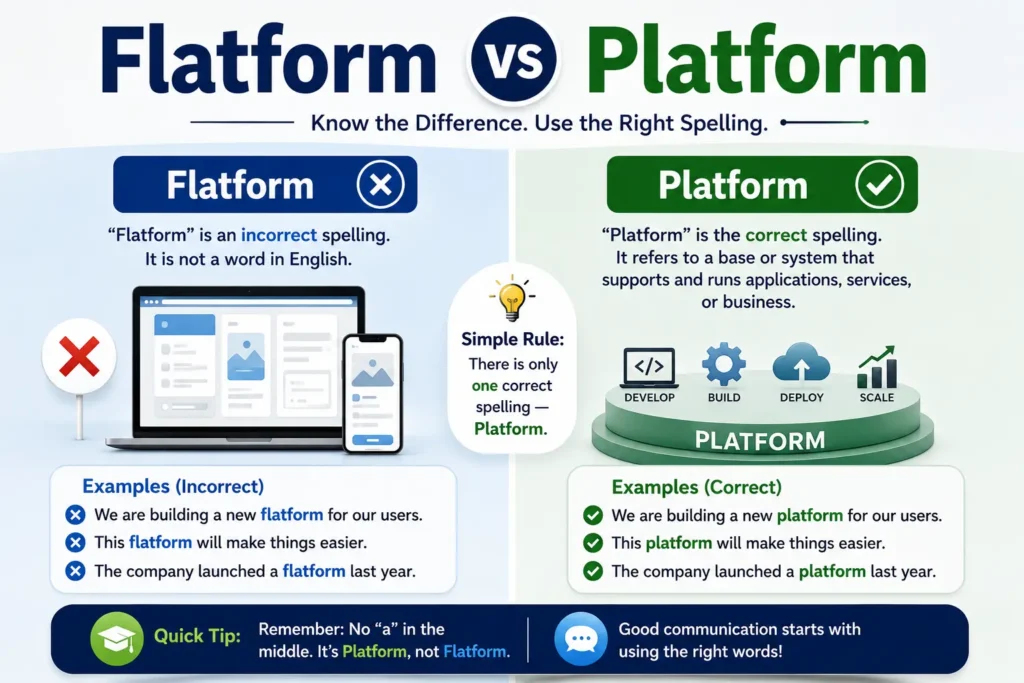
“Flatform” and “platform” are two different English words with different meanings. “Flatform” is a real word. Cambridge Dictionary defines it as a shoe with a thick sole that is equally flat from heel to toe. “Platform” is a much broader word. It can mean a raised structure, a thick-soled shoe, a technology foundation, or a political declaration. The key difference in flatform vs platform is simple: flatform refers only to a shoe type, while platform has many uses across many fields.
Have you ever read a fashion article and seen the word “flatform”? Maybe you stopped and thought, “Wait, is that a typo? Did they mean platform?”
You are not alone. This is one of the most common English word confusion mistakes people make. The two words look similar. They sound similar. But they are not the same.
This guide will clear things up fast. You will learn whether flatform is a real word, what both words mean, and exactly how to use each one correctly. Real example sentences are included for both.
Is “Flatform” a Real Word?
Yes, flatform is a real English word. It is not a misspelling of platform.
Cambridge Dictionary defines flatform as “a style of shoe with a very thick sole that is equally or almost equally thick at the front and back, so the foot is almost flat inside.” YourDictionary defines it as “a type of shoe with a flat, platform sole.”
Flatform is a portmanteau word. That means it was created by combining two words into one. In this case, those two words are “flat” and “platform.” Portmanteau words in English are very common. Words like “brunch” (breakfast and lunch) and “smog” (smoke and fog) were formed the same way.
So if you see the word flatform in a fashion article or on a shoe website, you are looking at a real, dictionary-approved English word with its own specific meaning.
What Does “Flatform” Mean?
A flatform is a type of shoe in which the sole is thick but completely flat from heel to toe. The foot stays entirely level inside the shoe. There is no angle, no slope, and no tilt.
This is what makes flatform shoes unique in fashion footwear terminology. The wearer gets extra height from the elevated sole, but the foot does not tilt forward the way it does in heeled shoes. The uniform sole thickness keeps everything flat.
Vogue has described flatform shoes as an “elevated sandal with an avant-garde, architectural aspect” that adds height while keeping the foot stable. This confirms that flatform is a well-recognized term in mainstream fashion writing.
Here are some example sentences using “flatform” correctly:
- “She wore white flatform sandals to the beach.”
- “These flatform sneakers have a two-inch elevated sole with the same thickness from front to back.”
- “Flatform boots are popular because they are easier to walk in than heeled platform boots.”
Flatform is only used in the context of footwear and fashion. You will not see it used in technology, politics, or architecture. It describes one specific thing: a shoe with a flat, equally thick elevated sole.
What Does “Platform” Mean? All the Different Uses
“Platform” is one of the most flexible words in the English language. It has more than five distinct meanings depending on the context.
Merriam-Webster defines platform as “a flat horizontal surface that is usually higher than the adjoining area.” Oxford Learner’s Dictionaries and Cambridge Dictionary expand this to cover many additional uses.
Here are the main meanings of platform in standard English:
1. A raised flat structure
A platform is any raised, flat surface that sits higher than the ground around it. Train stations are the most common example.
Example: “The train will arrive at platform nine in five minutes.”
2. A platform shoe
In fashion, a platform shoe is a shoe with a thick sole that raises the wearer’s height. According to Vionic Shoes, platform shoes “add substantial height while providing more stability and comfort than most traditional heels.”
Example: “Her platform heels added four inches to her height.”
3. A technology or software platform
In technology, a platform is the hardware or software foundation on which applications and services are built. ScienceDirect describes a software platform as “a software-based product or service that serves as a foundation on which outside parties can build complementary products or services.”
Example: “The app was developed for the iOS platform.”
4. A political platform
In politics, a platform is a declared set of principles or policies that a political party commits to.
Example: “The candidate ran on a platform focused on education reform.”
5. A communication or social media platform
In modern communication, a platform is any channel or service that gives people a means to share ideas with an audience.
Example: “She built a large following on a social media platform.”
As you can see, “platform” carries meaning across architecture, fashion, digital technology, politics, and communication. This broad word scope is what separates it most clearly from “flatform,” which is a shoe word and nothing more.
Flatform vs Platform: The Key Differences Explained
Now that both words are clearly defined, the flatform vs platform comparison becomes easy to see.
The key difference between flatform and platform is this: flatform refers only to a shoe with a uniformly flat elevated sole, while platform is a word with more than five distinct meanings across fashion, technology, architecture, and politics.
Here is a side-by-side comparison:
| Feature | Flatform | Platform |
| What it describes | A shoe type only | A word with 5+ meanings |
| Sole structure (in footwear) | Uniformly flat, same thickness heel to toe | Thick sole, may vary in height from heel to toe |
| Used in technology? | No | Yes |
| Used in politics? | No | Yes |
| Used in fashion? | Yes | Yes |
| Found in major dictionaries? | Yes (Cambridge, YourDictionary) | Yes (all major dictionaries) |
When it comes to footwear specifically, GrammarOrbit explains it well: “Platform shoes focus on height with flexible design, while flatform shoes focus on height with a fully flat base.”
Here are three more example sentences showing the correct use of each word:
- “Her flatform shoes kept her feet completely level despite the thick elevated sole.”
- “The company launched its new cloud computing platform last spring.”
- “The politician’s platform included promises to reduce housing costs.”
Use “flatform” only when talking about shoes. Use “platform” for everything else.
Where Does the Word “Platform” Come From?
Here is something surprising about the word platform that most people do not know.
According to etymology sources, “platform” comes from the Middle French word “plateforme.” In French, this word means “a flat form.” It combines two parts: “plate,” which means flat, and “forme,” which means form.
So the root of the word “platform” literally describes something flat. This is the same concept that “flatform” describes in English today. Both words share a connection to the idea of a flat surface, even though they arrived at that connection through very different paths.
This also helps explain why the two words are so easy to confuse. They share more than just similar spelling. They share a common concept at their roots.
Understanding this word origin makes it much easier to remember the difference. Platform is the broader word because it evolved from a simple description of a flat form into dozens of different uses over hundreds of years. Flatform is newer and more specific, using that same flat concept to describe one particular type of shoe sole.
When to Use “Flatform” and When to Use “Platform”
Choosing between these two words is actually straightforward once you know what each one means.
Use “flatform” when:
- You are describing or writing about a shoe with a thick, equally flat sole from heel to toe
- You are writing fashion content, product descriptions, or style guides
- You want to be precise about shoe vocabulary in English
Use “platform” when:
- You are talking about a raised structure such as a train station, a stage, or a viewing deck
- You are writing about shoes that have thick soles but are not necessarily flat from heel to toe
- You are discussing a digital platform, social media platform, or software platform in the context of technology
- You are describing a political platform or a set of declared principles
- You want to describe any means of communication or expression
A quick test: if you can replace the word with “a flat raised surface” and the sentence still makes sense, “platform” is almost certainly the right word. If you are describing a specific shoe with a completely flat sole, “flatform” is the correct choice.
Final Thoughts
Flatform and platform are two distinct English words that often cause confusion because they look and sound so similar.
Flatform is a real, dictionary-approved word. It is a portmanteau of “flat” and “platform,” and it describes a shoe with a thick, uniformly flat sole. Cambridge Dictionary and YourDictionary both confirm its legitimacy as a standard English word.
Platform is a far broader word with more than five recognized meanings. It can describe a raised structure, a thick-soled shoe, a digital technology foundation, a political declaration, or a social media channel.
The simplest way to remember the difference: flatform is always a shoe word. Platform is everything else.
If you found this guide helpful, explore more clear answers to English word questions on CorrectEnglish.org. Whether you are a student, a professional writer, or someone who just wants to use English with confidence, our word comparison guides are written to give you fast, accurate answers every time.