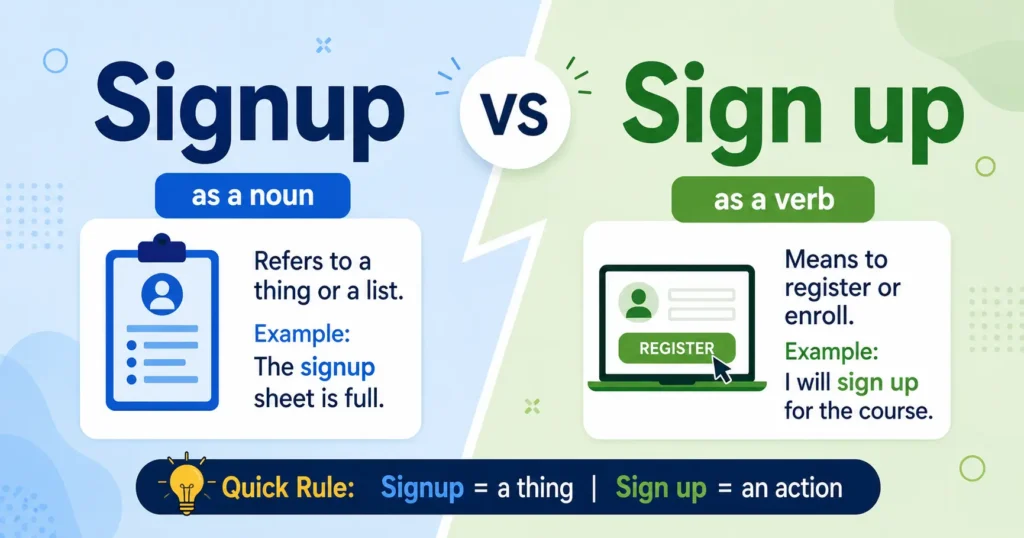
Use sign up when the phrase works as a verb, such as “You can sign up for the course.” Use signup or sign-up when the term works as a noun or adjective, depending on the style being followed. For example, “The signup process is easy” and “Complete the sign-up form.” The key is to check how the phrase functions in the sentence.
Introduction
You may see sign up, signup, and sign-up on websites, forms, and emails. So which one is correct? The answer depends on how the phrase is used in a sentence. Signup vs Sign up is mainly a question of grammar and word function. Sign up is usually a verb, while signup is commonly used as a noun. Sign-up can work as an adjective before another noun. In this guide, you will learn the difference between these forms, when to use each one, how sign-up works, common mistakes to avoid, and simple real-world examples.
Is It “Signup” or “Sign up”?
Sign up is the verb phrase used for the action of registering or joining something. Signup is generally used as a noun or adjective for the registration process, form, or related item. A third form, sign-up, is also used as a noun or adjective by some dictionaries and style guides.
| Form | Role | Example |
|---|---|---|
| sign up | Verb | Please sign up today. |
| signup | Noun/adjective | The signup process is simple. |
| sign-up | Noun/adjective | Complete the sign-up form. |
When to use “sign up”
Use sign up when you are talking about the action of registering, joining, or creating an account. It acts as a verb phrase.
Examples:
- Please sign up for the newsletter.
- You can sign up for a free account.
- Students must sign up before the class starts.
- Click the button to sign up for the service.
A simple test is to replace sign up with another verb, such as “register” or “join.” If the sentence still makes sense, sign up is likely the correct form.
For example:
Please register for the course.
Please sign up for the course.
Both sentences use the phrase as a verb.
When to use “signup”
Signup is often used as a noun to describe the registration process or an instance of registering. It can also be used as an adjective before a noun in some writing styles.
Examples:
- The signup process takes only a few minutes.
- We received 100 new signups this week.
- The website has a simple signup page.
- Our signup rate increased this month.
The exact use of signup can vary by dictionary, publication, or style guide. Some writers prefer sign-up in places where it acts as a noun or adjective.
When to use “sign-up”
Sign-up is another accepted form used as a noun or adjective. It is especially common in phrases such as sign-up form, sign-up page, and sign-up process.
Examples:
- Please complete the sign-up form.
- Visit the sign-up page to create an account.
- The sign-up process is quick and easy.
- We added a new sign-up option.
The important point is that sign up and signup/sign-up do not normally have the same grammatical role.
Quick rule: If someone needs to perform the action, use sign up. If you are naming the process, form, page, or result, signup or sign-up may be appropriate, depending on the style you follow.
When Should You Use “Sign Up”?
Use sign up when you are describing the action of registering, joining, enrolling, or subscribing to something. It functions as a phrasal verb, so it stays as two separate words.
Use “sign up” when you:
- Register for a class, event, website, or service
- Enroll in a course or program
- Join a group, club, or activity
- Subscribe to a newsletter, mailing list, or service
- Create an account or provide your details to access something
Examples
- I want to sign up for the class.
- You can sign up online.
- She decided to sign up for the newsletter.
- Please sign up before Friday.
- Many students sign up for the course each year.
- He wants to sign up for the new program.
Easy way to remember
If sign up describes something a person does, use the two-word form.
You sign up for something.
You do not normally write:
You signup for something. ❌
Instead, write:
You sign up for something. ✅
Here, sign up is a phrasal verb because the two words work together as one verb. The same pattern appears in sentences about registering, enrolling, joining, or subscribing.
When Should You Use “Signup”?
Signup is commonly used as a noun or adjective to describe registration, the registration process, or something related to registration. It is especially common in digital and technical writing, such as websites, apps, software, and online services.
Use “signup” when you are talking about:
- The registration process
- A registration page
- A new registration
- People who have registered
- Something related to creating an account
Examples
- The signup was quick.
- The signup process takes two minutes.
- Open the signup page.
- We received several new signups.
- The website has a simple signup form.
- Our signup rate increased this month.
“Signup” as a noun
When signup names the act or result of registration, it works as a noun.
For example:
The signup was easy.
Here, signup refers to the registration itself.
The plural form is signups:
We received 50 new signups this week.
“Signup” as an adjective
Signup can also describe something connected with registration.
For example:
The signup page is easy to use.
Here, signup describes the type of page. It tells readers that the page is used for registration.
Is “signup” always the correct form?
No. Signup is not universally preferred. Dictionary and style-guide preferences can vary. Dictionary.com recognizes signup as an alternative noun form, while some style guides prefer sign-up instead.
This means you may see both forms in reliable writing:
- signup process
- sign-up process
- signup page
- sign-up page
The best choice depends on the dictionary, style guide, or editorial rules you are following. The main grammar rule remains simple: use sign up as the verb phrase for the action of registering, while signup or sign-up can be used as a noun or adjective.
Is “Sign-up” Correct?
Yes. Sign-up is a correct form used as a noun or adjective in some dictionaries and style guides. The hyphen helps connect the words when they work together as one term.
You may see sign-up in phrases such as:
- sign-up form
- sign-up sheet
- sign-up deadline
- sign-up page
- sign-up process
“Sign-up” as a noun
As a noun, sign-up can refer to the act or process of registering.
For example:
The sign-up was quick and easy.
Here, sign-up names the registration process.
“Sign-up” as an adjective
Sign-up can also describe a noun related to registration.
For example:
Please complete the sign-up form.
In this sentence, sign-up describes the type of form.
Why is there a hyphen?
The hyphen in sign-up connects the two words when they work together as a noun or adjective. However, English spelling can change over time, and different dictionaries and publishers may use different forms.
For example, you may see:
sign-up form
signup form
Both forms can appear in published writing. The important thing is to follow the style guide or editorial rules used by your website, company, school, or publication.
American and British usage
There can be differences in spelling and style between American English and British English, but sign up, signup, and sign-up are all found in English writing. The choice often depends more on the dictionary or style guide than on whether the writer uses American or British English.
Dictionary.com lists sign-up as a noun and also gives signup as an alternative form. This shows why you may find more than one accepted spelling.
Quick rule
Use sign up for the verb:
Please sign up today.
Use sign-up or signup as a noun or adjective, based on the style you are following:
Complete the sign-up form.
Complete the signup form.
The key is to check the word function and keep your spelling consistent throughout your writing.
What Is the Difference Between Signup, Sign-up, and Sign up?
The main difference between signup, sign-up, and sign up is how each form works in a sentence. Sign up is normally a verb phrase. Signup and sign-up are generally used as nouns or adjectives. The meaning is closely related, but the spelling changes based on the word’s role and the style guide being followed.
| Form | Part of speech | Meaning | Example |
|---|---|---|---|
| sign up | Verb | Take the action of registering | I want to sign up. |
| signup | Noun/adjective | Registration or something related to registration | The signup process is easy. |
| sign-up | Noun/adjective | Same general noun/adjective function | The sign-up deadline is Friday. |
Sign up: the verb
Use sign up when someone is doing the action of registering, joining, enrolling, or subscribing.
Examples:
- I want to sign up for the class.
- Please sign up before Friday.
- You can sign up online.
- She plans to sign up for the newsletter.
Because sign up is a phrasal verb, it stays as two separate words.
Signup: the noun or adjective
Use signup when you are talking about the registration itself or something related to registration.
Examples:
- The signup was easy.
- The signup process takes two minutes.
- Open the signup page.
- We received several new signups.
The closed form signup is common in digital and technical writing, especially when discussing websites, apps, online accounts, and registration data.
Sign-up: the noun or adjective
Sign-up can also work as a noun or adjective. The hyphen connects the two parts of the term.
Examples:
- The sign-up deadline is Friday.
- Please complete the sign-up form.
- The sign-up sheet is on the desk.
- The sign-up process is simple.
Some dictionaries and style guides use sign-up, while others allow or prefer signup. This is why both forms can appear in reliable writing.
The easiest way to remember
Think about the action first:
Someone does it:
Please sign up today.
You are naming the process or related item:
The signup process is simple.
The sign-up process is simple.
So, the basic rule is:
sign up = verb
signup = noun/adjective
sign-up = noun/adjective
Always check the style guide you are following and use one preferred style consistently.
Is It “Sign Up Form” or “Signup Form”?
In standard usage, signup form or sign-up form is preferred because the term modifies the noun form. Sign up form is generally avoided when the phrase is working as a modifier.
Which form should you use?
| Form | Recommendation | Example |
|---|---|---|
| signup form | Correct | Please complete the signup form. |
| sign-up form | Correct | Please complete the sign-up form. |
| sign up form | Generally avoid | Please complete the sign up form. |
Correct: “signup form”
Signup form uses the closed form signup to describe a form used for registration.
Please complete the signup form to create your account.
This style is common in digital and technical writing.
Correct: “sign-up form”
Sign-up form uses the hyphenated form sign-up as an adjective before form.
Please complete the sign-up form before Friday.
This form is also widely used and follows the style of dictionaries and publishers that prefer the hyphen.
Avoid: “sign up form”
Sign up is normally a phrasal verb, so it is best used when describing the action:
Please sign up for an account.
When the phrase directly modifies form, many style guides prefer signup form or sign-up form:
Please complete the signup form.
Please complete the sign-up form.
What if your style guide says otherwise?
House styles can differ. A website, company, school, or publisher may choose signup or sign-up as its preferred form. Either way, consistency is important.
If your style guide uses signup form, use that spelling throughout your content. If it uses sign-up form, follow the same rule across your pages, forms, buttons, and other materials.
Quick answer: Choose signup form or sign-up form. Use sign up when you are describing the action of registering.
Is “Sign Up” One Word or Two?
When sign up is used as a verb, it is written as two words. For example, “Users can sign up for free.” The one-word form signup is generally used as a noun or adjective, not as the verb.
Verb: Users can sign up for free.
Noun: The signup was quick.
The easiest rule is simple: if you are describing the action of registering, use sign up.
Common Mistakes With Signup and Sign up
A common mistake is using signup as a verb. Another mistake is writing sign up as two words when it is being used as a modifier before a noun.
| Incorrect | Better |
|---|---|
| I want to signup. | I want to sign up. |
| Users can signup today. | Users can sign up today. |
| Click here to signup. | Click here to sign up. |
| The sign up form is ready. | The signup form is ready. |
| The signup process is easy. | Correct |
Why are these forms different?
Sign up is a verb phrase. It describes an action that someone takes.
I want to sign up.
Here, the person is taking the action of registering.
Signup is generally a noun or adjective. It can describe registration, the registration process, or something related to registration.
The signup process is easy.
Here, signup describes the type of process.
The same basic rule applies to online registration, account creation, newsletters, classes, events, and subscriptions.
How Do You Use “Signup” in a Sentence?
Use signup as a noun or adjective when you are talking about registration or something connected to the registration process.
Here are some simple examples:
- The signup process is simple.
- We improved the signup page.
- The signup form asks for an email address.
- New signups increased this month.
- The signup deadline is Friday.
- The website has a simple signup option.
Remember the difference
If someone does the action, use sign up:
New users can sign up today.
If you are naming the process, page, form, or result, signup can be used:
The signup page is ready.
This small grammar difference makes it easier to choose the correct form in your writing.
How Do You Use “Sign up” in a Sentence?
Use sign up as a verb when you are talking about the action of registering, joining, enrolling, or subscribing.
Examples:
- You can sign up online.
- I signed up for the course.
- Please sign up before Monday.
- They want to sign up for the newsletter.
- She signed up yesterday.
Remember that sign up stays as two words when it is used as a verb. The verb can also change form, such as signed up for the past tense.
Signup vs Sign up in Digital Writing
The difference between signup and sign up is especially important in digital writing. Websites, apps, emails, forms, and software often use these terms for account registration and user actions.
CTA buttons
A call to action (CTA) button usually tells the user what action to take. Since the button asks the user to register, use sign up:
Sign up
Other examples include:
Sign up for free
Sign up now
Forms
When signup describes a registration form, it can be written as one word:
Complete the signup form.
Some style guides prefer the hyphenated form:
Complete the sign-up form.
The important point is that sign up form is generally avoided when the phrase works as a modifier.
Websites and signup pages
Digital products often have a signup page where users create an account.
Visit the signup page to create an account.
When describing the action, use the two-word verb:
Users can sign up for an account.
Emails
The same rule applies to email writing.
Sign up for our newsletter.
But when discussing the registration process, use a noun form:
The signup process takes two minutes.
Headings
Headings can use either form depending on their role:
Sign up for an account
Signup process
Sign-up form
If the heading tells readers to take an action, sign up is the verb. If it names a process or item, signup or sign-up may be appropriate.
Analytics terminology
Digital analytics often use signup as a noun when measuring registrations.
For example:
We received 500 new signups this month.
Here, signups refers to people or registration events. You may also see terms such as signup rate, signup conversion, and signup page in analytics and product reports.
Quick digital writing guide
| Digital use | Preferred form | Example |
|---|---|---|
| CTA button | sign up | Sign up |
| Action in a sentence | sign up | Users can sign up today. |
| Registration process | signup or sign-up | The signup process is easy. |
| Registration page | signup or sign-up | Open the signup page. |
| Registration form | signup or sign-up | Complete the sign-up form. |
| Analytics | signup | New signups increased. |
The simple rule still works in digital writing: sign up describes the action, while signup and sign-up are generally used for the registration process or something related to it. Choose the noun form required by your style guide and use it consistently.
What Is the Easy Way to Remember the Difference?
Remember this simple rule: sign up = action and signup/sign-up = thing or description. If you can replace the phrase with register, you probably need sign up. If you are talking about the registration itself, signup or sign-up may be appropriate.
Easy memory trick
Action = two words.
Thing or description = one word or hyphenated.
For example:
Users can sign up today.
The signup process is easy.
Complete the sign-up form.
This simple test can help you choose the right form quickly.
Conclusion
The easiest way to remember signup vs sign up is to focus on the word’s job in the sentence. Use sign up for the action of registering, joining, enrolling, or subscribing. Use signup or sign-up when referring to the registration itself or something related to it.
Still unsure about another commonly confused English word? Explore more grammar guides for simple explanations and clear examples.
FAQ
1. Is “signup” one word?
Yes. Signup is used as a noun and, in some style systems, as an adjective. For example, “The signup process is simple.” However, when the phrase is a verb, use sign up as two words.
2. Is “sign up” two words?
Yes, when it functions as a verb. For example, “You can sign up for the newsletter.” The verb form should not normally be written as signup.
3. Is “sign-up” correct?
Yes. Sign-up is a recognized noun form and is also used as an adjective in phrases such as sign-up form. Some style guides use the closed form signup instead, so consistency matters.
4. Should I write “sign up form” or “signup form”?
Signup form or sign-up form is preferred when the phrase modifies form. The verb phrase sign up is normally kept separate when describing an action, as in “Users can sign up for an account.”
5. Can “signup” be used as a verb?
In standard usage, use sign up as the verb. For example, write “Please sign up today,” not “Please signup today.” Signup is generally used as a noun or adjective.
6. Which is correct on a website button: “Sign Up” or “Signup”?
Use Sign Up when the button asks users to perform the action of registering. It works as an imperative verb phrase. The noun form signup is better suited to labels describing the registration process or feature.
7. Is “signup” or “sign-up” more correct?
Both forms are used for the noun, but style preferences differ. Some references recognize signup, while others use sign-up. The important distinction is that the verb remains sign up. Follow the dictionary or house style used by your publication.