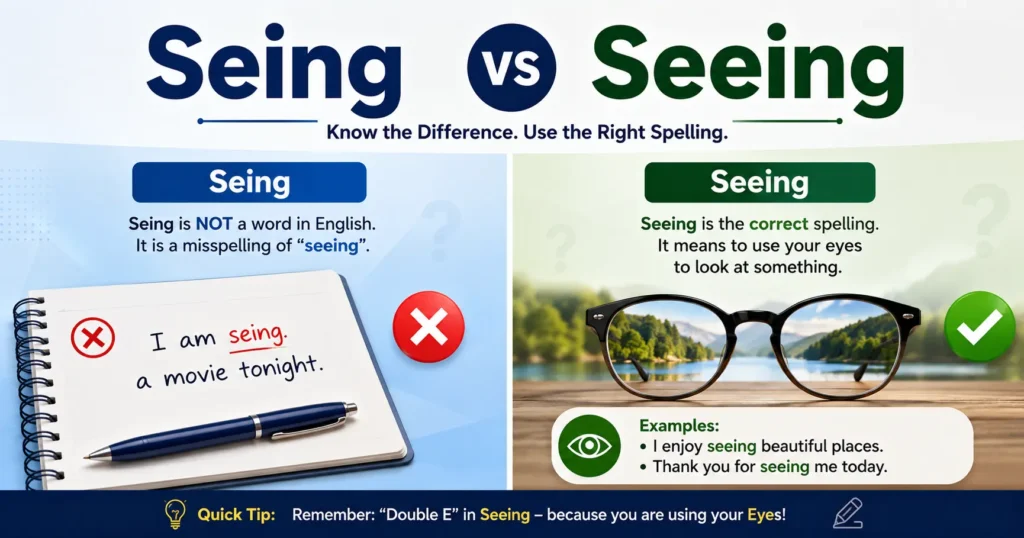
“Seeing” is the correct spelling in modern English. “Seing” is always a misspelling. “Seeing” is the present participle of the verb “see,” formed by adding -ing to the base word while keeping both E’s. It means the act of perceiving, observing, or understanding something. Whenever you mean visual perception or observation, “seeing” with a double-E is the only correct form to use.
Have you ever typed a word and then stopped to wonder, “Wait, is that actually spelled right?” That moment of doubt happens to a lot of writers. The question of seing or seeing is one of those small spelling traps that can trip up even careful writers. The good news is that the answer is simple and easy to remember. This article gives you the correct spelling, explains exactly why, and shows you how to use “seeing” the right way in every kind of sentence.
Is “Seing” a Real Word?
Here is the short answer: “seing” is not a word in modern English. It is a misspelling of “seeing.”
In very old, archaic English, the word “seing” referred to a signature or a mark of endorsement. That usage has been obsolete for centuries and plays no role in everyday writing today. There is no situation in current English grammar where “seing” is the correct choice. If you write “seing,” it will always be read as a typo.
So the question of seing or seeing has one clear winner. It is “seeing,” every single time.
Why Does “Seeing” Have Two E’s?
This is the most helpful part, because once you understand the spelling rule, you will never mix this up again.
The base verb is “see.” Look at how it is spelled: S-E-E. It already ends in two E’s. When you add the suffix -ing to form the present participle, you simply attach -ing to the full base word. You do not drop any letters.
So the word formation works like this:
see + ing = seeing (S-E-E-I-N-G)
That is why the correct spelling of seeing always has a double E in the middle. There is no E to drop, and no spelling rule that removes it.
Here is a quick mnemonic that makes this easy to remember:
“You need two eyes to see. You need two E’s to spell seeing.”
This trick alone will lock the correct spelling into your memory. The double-E in “seeing” directly mirrors the double-E in “see.”
Some writers confuse this with verbs like “come,” where the final E is dropped before adding -ing (come + ing = coming). However, that rule only applies to words that end in a single silent E. The verb “see” ends in two E’s, so the rule is different.
What Does “Seeing” Mean?
“Seeing” is the present participle of the verb “see.” It is used to describe the act of perceiving, observing, or noticing something with your eyes. It can also mean understanding or comprehending an idea.
According to the Cambridge Dictionary, “see” refers to the act of being aware of what is around you through your eyes. “Seeing” takes that base meaning and applies it in continuous or ongoing contexts.
“Seeing” as a Verb
When used as a verb in a continuous tense, “seeing” describes an action currently happening or ongoing over time.
- “I am seeing a doctor on Friday.”
- “She was seeing a beautiful sunrise from her window.”
- “We are seeing real progress in the project.”
In each of these sentences, “seeing” is a participial verb showing an ongoing action or visual perception.
“Seeing” as a Noun (Gerund)
When “seeing” acts as a gerund, it works as a noun in the sentence. A gerund is a verb form that takes on the role of a noun.
- “Seeing is believing.”
- “Seeing the error clearly helped her fix it.”
In the first example, “seeing” is the subject of the sentence. It is not describing an action in progress. Instead, it names a concept, just like any noun would.
“Seeing” in Common Phrases and Idioms
“Seeing” also appears in several well-known idiomatic expressions:
- “Seeing red” means feeling very angry or losing your temper. Example: “He was seeing red after the unfair call.”
- “Seeing is believing” means you can only be sure of something once you have witnessed it yourself.
- “Not seeing eye to eye” means disagreeing with someone.
These phrases use the word “seeing” in figurative rather than literal ways. The spelling, however, is always the same.
“Seeing” Used in Sentences: Real Examples
The best way to get comfortable with a word is to see it used naturally. Here are clear examples of “seeing” across different contexts:
- Visual perception: “I am seeing the mountains for the first time.”
- Appointment or meeting: “She is seeing her dentist tomorrow morning.”
- Romantic use: “They have been seeing each other for six months.”
- Gerund (noun) use: “Seeing the finished project made everyone proud.”
- Idiomatic use: “He was seeing red when he heard the news.”
- Understanding: “I am finally seeing the full picture now.”
In every single one of these sentences, the spelling is seeing with a double E. There is no version of these sentences where “seing” would be acceptable.
The Difference Between “See” and “Seeing”
Both “see” and “seeing” come from the same verb, but they work differently in a sentence.
“See” is the base form of the verb. It is used in simple tenses and with certain helping verbs.
- “I see you.”
- “Can you see the sign?”
- “I will see him later.”
“Seeing” is the present participle form. It is used in continuous tenses and as a gerund.
- “I am seeing the results.”
- “Seeing the truth helped him move on.”
One important grammar note: “see” as a stative verb (describing passive visual awareness) is usually not placed in a continuous tense. You say “I see him” rather than “I am seeing him” when you simply mean your eyes are registering someone. However, when “seeing” describes an active appointment, encounter, or dynamic experience, the continuous form is perfectly correct.
The key takeaway is that the choice between “see” and “seeing” depends on the tense and structure you need. Both forms follow standard English grammar rules, and both are spelled in full without dropping any letters.
A Simple Way to Remember the Correct Spelling
If you find yourself second-guessing this word, come back to the base rule:
- Start with the verb: see (S-E-E)
- Add the suffix: -ing
- Result: seeing (S-E-E-I-N-G)
No letter is dropped. No letter is changed. The word formation rule is completely straightforward.
You can also run your writing through a grammar checker to catch spelling errors like “seing” before they reach your reader. Modern grammar tools check for exactly this kind of common misspelling in real time, so nothing slips through.
Final Thought
The answer to seing or seeing is clear: seeing is always correct, and seing is always a spelling error in modern English. The double-E comes directly from the base verb “see,” and the word formation rule is one of the most consistent in English grammar.
Whether you are using “seeing” as a verb in a continuous tense, as a gerund acting like a noun, or as part of a common idiom, the spelling never changes. Two E’s, every time.
If you want to make sure spelling mistakes like “seing” never appear in your writing again, try the CorrectEnglish grammar checker. It catches errors like these in real time and works right inside your browser, so your writing always looks polished and professional. Install the free Chrome extension and write with full confidence from your very first word.