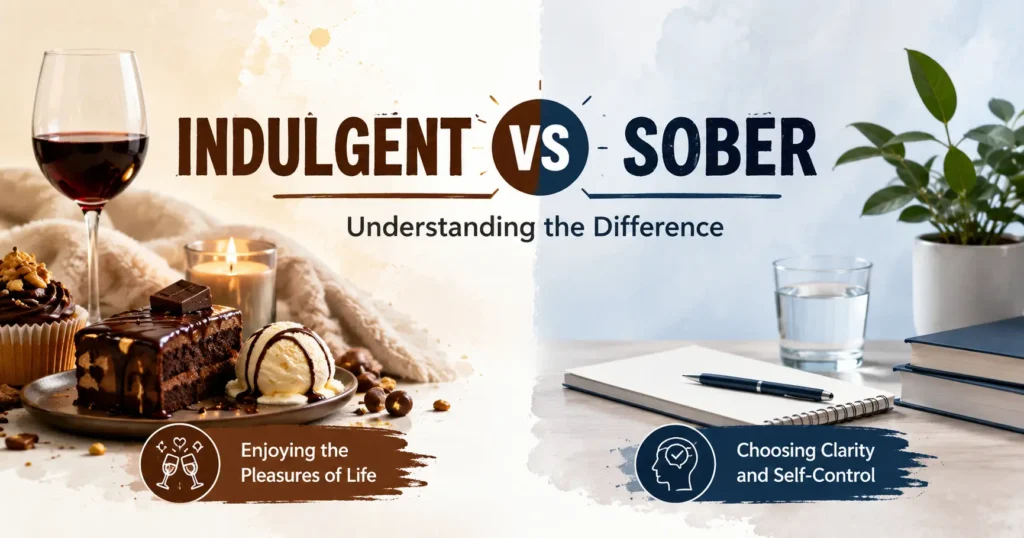
Indulgent and sober are adjectives that describe opposite ends of the restraint spectrum. Indulgent means giving in to pleasure, being lenient, or embracing excess. Sober means being restrained, serious, clear-headed, or free from intoxication. Knowing which word fits your sentence depends on the context and the tone you want to set.
Some adjectives look like simple opposites but behave in surprisingly different ways depending on the sentence. Indulgent and sober are two of those words. Understanding the difference between indulgent and sober helps you choose the right word every time, whether you are writing an essay, a story, or a professional email. This guide breaks down the exact meaning of each adjective, shows you how to use both words in a sentence, and helps you avoid the most common mix-up writers make.
What Does “Indulgent” Mean?
Indulgent is an adjective that describes a tendency to give in to desires, enjoy pleasures, or show leniency toward others. It comes from the idea of indulging, which means allowing something pleasurable to happen without resistance.
The word carries different shades of meaning depending on context. It can describe a person, a behavior, a choice, or even a food item.
Examples of indulgent in a sentence:
- “She gave her son an indulgent smile when he asked for a second piece of cake.”
- “The restaurant is famous for its indulgent desserts loaded with cream and chocolate.”
- “He was an indulgent parent who rarely said no to his children.”
Notice that indulgent is not always a negative word. It can suggest warmth and affection, especially in parenting and personal relationships. It only becomes negative when it points to harmful excess or a clear lack of self-restraint.
Common synonyms for indulgent: lenient, permissive, forbearing, tolerant, gratifying.
What Does “Sober” Mean?
Sober is one of those adjectives that carries more than one meaning, and that is exactly where many writers get confused. It is important to understand all three main uses before you pick it for a sentence.
Sober as “Not Intoxicated”
The most well-known meaning of sober is simply not drunk or not under the influence of alcohol. This is the first definition most dictionaries list.
Examples:
- “The driver was completely sober when police stopped the vehicle.”
- “She stayed sober throughout the evening so she could drive everyone home.”
Sober as a Personality or Tone Adjective
This is where sober gets more interesting for writers. When used to describe a person, a response, or a mood, sober means serious, calm, measured, dignified, and not given to exaggeration or playfulness.
Vocabulary.com describes a sober person as “completely lacking in playfulness” and “dignified and somber in manner”. Merriam-Webster adds that sober means “marked by sedate or gravely or earnestly thoughtful character or demeanor”.
Examples:
- “The judge gave a sober assessment of the evidence before the court.”
- “He replied in a sober tone that made everyone in the room fall quiet.”
Sober as an Aesthetic Adjective
Sober can also describe colors, clothing, and design styles. In this context, it means subdued, muted, dull, or restrained in appearance.
Examples:
- “She wore a sober grey dress to the formal ceremony.”
- “The office had a sober interior with plain white walls and minimal decoration.”
Common synonyms for sober: serious, sedate, solemn, grave, earnest, restrained, temperate, subdued.
What Is the Main Difference Between Indulgent and Sober?
The core difference between indulgent and sober is the direction of restraint. Indulgent leans toward allowing and pursuing pleasure, desire, or gratification. Sober leans toward self-control, seriousness, and moderation.
Think of it this way: an indulgent person says yes to pleasure. A sober person holds back, thinks clearly, and keeps their emotions in check.
The table below shows how the two adjectives contrast across key dimensions.
| Dimension | Indulgent | Sober |
| Core meaning | Giving in to desires; lenient; pleasure-seeking | Restrained; serious; not intoxicated |
| Personality use | Warm, permissive, self-gratifying | Calm, measured, disciplined |
| Tone | Warm or excessive depending on context | Grave, subdued, clear-headed |
| Aesthetic use | Rich, luxurious, lavish | Muted, plain, understated |
| Opposite of | Restrained, abstemious, sober | Playful, indulgent, intoxicated |
One important point: these two words are not always direct antonyms. When sober refers specifically to being free from alcohol, it does not directly oppose indulgent. The contrast becomes clear only when sober is used in its personality or restraint sense.
How Do You Use Each Word in a Sentence?
Seeing both words in real sentence contexts is the fastest way to lock in the difference. Below are multiple examples for each word across different usage situations.
Indulgent in a Sentence
- “The spa offered an indulgent three-hour treatment with hot stones and aromatherapy.”
- “Her indulgent nature made it hard for her to enforce any rules at home.”
- “He spent the afternoon in a gloriously indulgent way, doing absolutely nothing productive.”
- “The recipe called for an indulgent amount of butter and heavy cream.”
- “She had an indulgent streak that her coworkers found both charming and exhausting.”
Sober in a Sentence
- “It was a sober reminder that not all problems have easy solutions.”
- “He dressed in a sober dark suit suitable for the memorial service.”
- “After years of struggle, she had been sober for three years and counting.”
- “The professor spoke in a sober, measured voice that commanded the room.”
- “The report offered a sober analysis of the country’s economic risks.”
Reading through both sets of sentences, you can see how indulgent brings warmth, softness, or richness while sober brings weight, restraint, and seriousness. That tonal difference is the key signal for writers.
Are Indulgent and Sober Antonyms?
Indulgent and sober can function as antonyms, but only in certain contexts. When sober carries its meaning of restrained, serious, or self-controlled, it sits clearly opposite to indulgent. In that usage, the two words describe opposite ends of the same behavior spectrum.
However, when sober refers specifically to not being drunk, it does not directly oppose indulgent. A person can be both sober (not intoxicated) and indulgent (eating lavishly or being overly permissive) at the same time.
If you need a clean, direct antonym for indulgent, better choices include:
- Restrained (holding back from excess)
- Abstemious (sparing in consumption)
- Temperate (moderate in behavior or habits)
- Disciplined (controlled and self-directed)
Similarly, the clearest antonym for sober in the “serious/restrained” sense is playful or frivolous. In the alcohol sense, the antonym is drunk or intoxicated.
Synonyms for Indulgent and Sober
Building your vocabulary around these two adjectives also means knowing their closest synonym neighbors. The table below gives you the most useful options for both words.
| Indulgent Synonyms | Sober Synonyms |
| Lenient (allowing; not strict) | Serious (earnest; thoughtful) |
| Permissive (giving too much freedom) | Sedate (calm; settled in manner) |
| Tolerant (accepting of excess) | Solemn (grave; dignified) |
| Forbearing (patient; restrained in judgement) | Temperate (moderate; avoiding excess) |
| Self-gratifying (focused on personal pleasure) | Restrained (controlled; not excessive) |
| Luxurious (rich; comfortable beyond basic needs) | Subdued (quiet; not lively or bright) |
Using these synonyms in your writing adds variety without changing the core meaning. For example, instead of repeating indulgent, you could swap in permissive or lenient when describing a person, or luxurious when describing a setting or product.
Which Word Should You Use? A Quick-Reference Guide
Choosing between indulgent and sober becomes easy when you ask yourself one simple question: Is this sentence about allowing pleasure, or about holding back?
Use the checklist below to make the right call every time.
- Is the sentence about enjoying, treating, or giving in to something pleasurable? Use indulgent
- Is the sentence about being serious, calm, clear-headed, or measured? Use sober
- Is the sentence about being free from alcohol or drugs? Use sober
- Is the sentence about a muted color, plain clothing, or restrained design? Use sober
- Is the sentence about showing leniency or warmth toward someone else’s desires? Use indulgent
- Is the tone of the sentence warm and soft? Indulgent likely fits
- Is the tone of the sentence grave, thoughtful, or disciplined? Sober likely fits
One extra tip for ESL learners: if you are ever unsure, try replacing the word with its core synonym. Replace indulgent with lenient or pleasure-seeking. Replace sober with serious or restrained. If the sentence still makes sense, you have the right word.
A Note on Indulgent and Sober in Personality Descriptions
Both adjectives are widely used in personality vocabulary, and they describe very different people.
An indulgent personality tends to be generous, warm, pleasure-seeking, and lenient. This type of person prioritizes enjoyment and is usually easygoing. However, in excess, an indulgent personality can struggle with self-discipline or long-term goal-setting.
A sober personality tends to be disciplined, serious, rational, and restrained. This type of person makes decisions carefully and avoids impulsive or excessive behavior. A sober person is often described as reliable, steady, and clear-headed.
Interestingly, the OpenPsychometrics character personality project uses the indulgent-sober axis as a direct rating scale, placing well-known fictional characters along a spectrum from maximally indulgent to maximally sober. This shows how broadly these two words apply when describing human behavior and personal style.
It is also worth noting that in cross-cultural studies, Geert Hofstede identified “Indulgence versus Restraint” as one of six key cultural dimensions. Indulgent societies tend to value personal freedom, happiness, and leisure. Restrained societies tend to regulate gratification through social norms and discipline. This gives the indulgent vs sober contrast a layer of meaning that goes well beyond grammar.
Final Thoughts
Understanding the difference between indulgent and sober gives you real control over tone and meaning in your writing. These two adjectives carry completely different emotional weight. Indulgent brings warmth, richness, and a sense of giving in to something enjoyable. Sober brings gravity, restraint, and a sense of clear-headed discipline.
Neither word is better than the other. The right choice always depends on what you want your sentence to feel like. When in doubt, go back to the core contrast: pleasure versus restraint. That single question will point you to the correct adjective almost every time.
If you want to make sure every word choice in your writing lands the way you intend, the CorrectEnglish writing assistant checks adjective usage, word substitutions, and context-based errors across more than 63,000 grammar rules. It is a simple way to write with more confidence and accuracy every time you put words on the page.