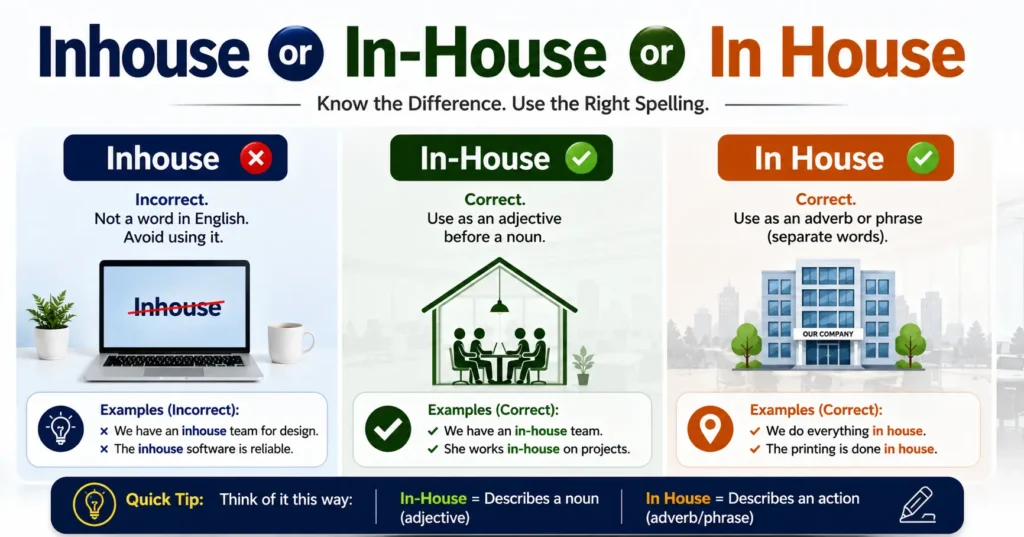
Should you write inhouse, in-house, or in house? If you have stopped mid-sentence trying to figure out the right answer, you are not alone. All three versions look familiar, and spell-checkers do not always catch the wrong one. The good news is that the answer is clear and easy to remember. “In-house” with a hyphen is the correct spelling in professional and business writing. This article explains why, shows you the grammar rule behind it, and gives you six ready-to-use example sentences.
“In-house” with a hyphen is always the correct spelling when used as an adjective or adverb in professional and business writing. “Inhouse” as one word is not recognized by any major English dictionary. “In house” without a hyphen is only correct as a literal prepositional phrase meaning physically inside a building. For all professional writing contexts, always use “in-house.”
What Is the Correct Spelling: Inhouse, In-House, or In House?
The correct spelling is “in-house” with a hyphen. This is the form listed in Merriam-Webster, Cambridge Dictionary, and Britannica Dictionary.
“Inhouse” written as one word is not a recognized English word in any major dictionary. It is a common typing error that sometimes slips past autocorrect tools, but it is always wrong in standard English.
“In house” written as two words with no hyphen is only correct in the literal sense, meaning physically inside a building. In any business writing context where you mean internally managed or done within a company, the two-word unhyphenated form is incorrect.
Here is a quick side-by-side comparison of all three spellings:
| Spelling | Correct? | When to Use It | Example |
| in-house | YES, always correct | As an adjective or adverb in professional and business writing | “We have an in-house legal team.” |
| in house | SOMETIMES, literal only | Only as a prepositional phrase meaning physically inside a building | “The children played in the house.” |
| inhouse | NO, never correct | Not a recognized word in any major English dictionary | Not applicable |
According to Merriam-Webster, “in-house” means “existing, originating, or carried on within a group or organization or its facilities: not outside.” Cambridge Dictionary defines it as “done within an organization or business by its employees rather than by other people.”
Both definitions describe the same concept: work or operations that happen internally, inside a company, rather than being sent to an outside provider. The hyphenated form “in-house” carries this meaning in all standard professional writing.
Why “In-House” Needs a Hyphen: The Compound Adjective Rule
The reason “in-house” requires a hyphen comes down to a grammar rule called the compound adjective rule. A compound adjective is when two words join together to describe a single noun. When that happens, you connect the two words with a hyphen.
For example:
- “in-house team” (two words, “in” and “house,” work together to describe one noun, “team”)
- “full-time employee” (two words describe “employee”)
- “well-known author” (two words describe “author”)
The hyphen is a signal to the reader. It says: these two words are working as one unit, not as two separate ideas. Without the hyphen, the words could be read separately and create confusion.
Scribbr explains this clearly: “When a compound adjective appears in the attributive position, meaning directly before the noun it modifies, it should be hyphenated.” The same rule applies to “in-house.” It is a compound modifier, and it gets a hyphen.
According to Grammarly, “a hyphen is a punctuation mark used to join words or parts of words, forming compounds.” This is exactly what happens with “in-house.” The hyphen joins “in” and “house” into a single compound word with one shared meaning.
Business writing style guides follow this same standard. The AP Stylebook and the Chicago Manual of Style both require hyphenating compound adjectives that appear before a noun. Both confirm that “in-house” is written with a hyphen in professional writing.
Does the Position in the Sentence Change the Hyphen?
This is where many writers get confused. The position of “in-house” in a sentence can affect whether the hyphen is required. There are two positions to know: attributive position and predicate position.
Attributive Position: Before the Noun
When “in-house” comes directly before the noun it is describing, it is in the attributive position. In this position, the hyphen is always required.
- “The company has an in-house marketing team.”
- “We completed in-house training last week.”
The word “in-house” comes right before “team” and “training” in those sentences. The hyphen is required in both.
Predicate Position: After a Linking Verb
When “in-house” appears after a linking verb like “is,” “was,” or “handled,” it is in the predicate position. Some style guides allow the hyphen to be dropped in this position. However, Merriam-Webster lists “in-house” with a hyphen in both positions.
- “All legal review is handled in-house.”
- “The project was completed in-house.”
The safest rule for professional writing is this: keep the hyphen in all positions. Whether “in-house” comes before the noun or after the verb, the hyphenated form is always correct and never wrong. Dropping the hyphen in predicate position is optional in some styles, but keeping it is universally accepted.
Using “In-House” as an Adjective and as an Adverb
Most people use “in-house” as an adjective, meaning it describes a noun. But “in-house” also works as an adverb, meaning it can modify a verb. Both Merriam-Webster and Cambridge Dictionary confirm that “in-house” functions as both parts of speech.dictionary.
Here is how each use works:
| Part of Speech | How It Works | Example |
| Adjective | Describes a noun that follows it | “We rely on our in-house design team.” |
| Adjective | Describes a noun in any position | “The in-house report was approved.” |
| Adverb | Modifies a verb, usually at the end of a sentence | “All content is written in-house.” |
| Adverb | Describes how an action is performed | “The product was developed in-house.” |
Britannica Dictionary confirms: “in-house testing” and “an in-house investigation” are both correct adjective uses. The adverb use appears in sentences like “all work is done in-house.”
No matter which part of speech you use, the hyphenated spelling stays the same. “In-house” is always written with a hyphen whether it is an adjective or an adverb.
In-House in a Sentence: 6 Correct Examples
Here are six example sentences showing correct use of “in-house” across the most common business writing situations. Each one uses the hyphenated spelling in its proper context.
- Job description: “We are looking for a candidate to join our in-house creative team.”
- HR communication: “All employees are required to complete the in-house compliance training by Friday.”
- Company announcement: “The development work will be handled in-house rather than outsourced to a third party.”
- Project update: “The legal review was conducted in-house and approved by the end of the quarter.”
- Marketing copy: “Our in-house writers produce all content for the brand.”
- Business proposal: “By keeping production in-house, the company reduces costs and maintains quality control.”
Notice that sentences 1, 2, and 5 use “in-house” as an adjective, coming directly before a noun. Sentences 3, 4, and 6 use it as an adverb, coming after the main verb. In both cases, the hyphen stays.
What Style Guides and Dictionaries Say About “In-House”
Every major English authority agrees on the same answer. Here is a brief summary of what each one says:
- Merriam-Webster: Lists only “in-house” as the correct spelling. Defines it as existing or carried on within a group or organization. Confirms both adjective and adverb use.
- Cambridge Dictionary: Lists “in-house” with a hyphen. Covers both British and American English. Confirms use as an adjective and adverb.
- Britannica Dictionary: Lists “in-house” as a compound adjective used before a noun, with examples including “in-house testing” and “an in-house adviser.”
- AP Stylebook: Requires hyphenation of compound adjectives before nouns. This rule applies directly to “in-house” in all professional writing contexts.
- Chicago Manual of Style: Follows the same compound modifier rule. Hyphenate compound adjectives that precede the noun they modify. “In-house” qualifies under this rule.
The agreement across all five sources is clear. “In-house” is the only correct spelling in standard English. Whether you follow AP style for journalism, Chicago style for academic writing, or use Merriam-Webster as your dictionary reference, the answer is the same.
Final Thoughts: One Hyphen, One Rule, One Correct Answer
The spelling question “inhouse or in-house or in house” has a simple answer: always use “in-house” with a hyphen in business writing and professional communications. The rule behind it is the compound adjective rule, which applies across all major style guides including AP Stylebook and Chicago Manual of Style, and is confirmed by Merriam-Webster, Cambridge Dictionary, and Britannica Dictionary.
Keep the hyphen whether “in-house” comes before a noun or after a verb. Use it as an adjective to describe a team, a process, or a department. Use it as an adverb to describe how work is performed. The hyphenated form is correct in every case.
When in doubt, check the rule: two words that work together as one compound modifier before a noun always take a hyphen. “In-house” follows this rule every single time.
Browse more grammar and spelling guides on CorrectEnglish.org to sharpen your business writing, professional communications, and everyday English usage with clear, reliable rules you can apply right away..