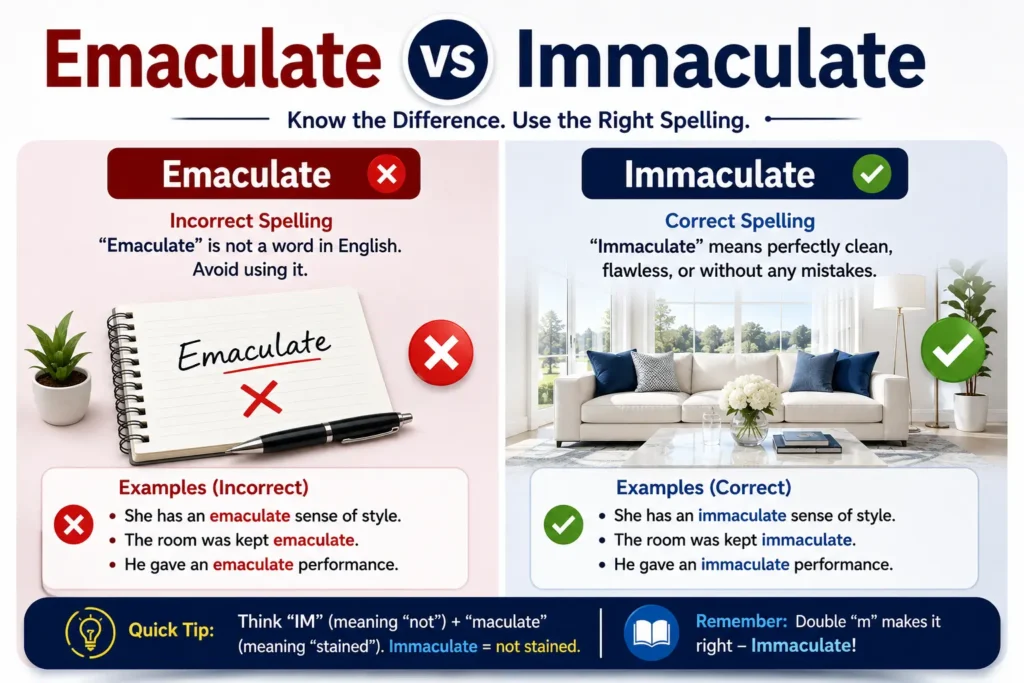
“Emaculate” is not a recognized word in standard English. It is a common misspelling of “immaculate.” The correct spelling is always “immaculate.” Merriam-Webster, Cambridge Dictionary, and Oxford Learner’s Dictionaries all confirm that “immaculate” is the only correct form. It means perfectly clean, free from any flaw or error, or morally pure. The word comes from the Latin “immaculatus,” meaning “not stained.” Always use “immaculate” in both formal and everyday writing.
Have you ever typed the word “emaculate” and then stopped to wonder if you spelled it right? Maybe you have seen both spellings and are not sure which one is correct.
You are in the right place. This is one of the most common English spelling mistakes that writers, students, and ESL learners make. In this guide, you will get a clear answer on the correct spelling, a full definition of immaculate, and a simple memory trick so you never make this mistake again.
Let us start with the most important question first.
Is “Emaculate” a Real Word?
No. “Emaculate” is not a real word in modern standard English.
It does not appear in Merriam-Webster, Cambridge Dictionary, Oxford Learner’s Dictionaries, or Dictionary.com. None of these major dictionaries recognize “emaculate” as a valid English word. It is simply a misspelling of “immaculate.”
The emaculate spelling is one of the most common English spelling mistakes because of the way “immaculate” sounds when you say it out loud. The “im” at the start of the word can sound like “em” to many listeners, especially ESL learners and fast speakers. That sound-based spelling mistake is the main reason this confusion exists.
You may occasionally see a very old, rare, and archaic use of the word “emaculate” in old texts, meaning to remove spots or blemishes. But this usage is not found in any modern dictionary and has no place in current everyday or formal English writing. If you have written “emaculate” in a document, replace it with “immaculate” right away.
The correct spelling is always “immaculate.”
What Does “Immaculate” Mean?
“Immaculate” is an adjective in English. It means spotlessly clean, free from any flaw or error, or morally pure.
According to Merriam-Webster, immaculate means “spotlessly clean” and “having or containing no flaw or error.” Cambridge Dictionary defines it as “perfectly clean or tidy” and “perfect and without any mistakes.” Oxford Learner’s Dictionaries adds that it can also describe something as “without a blemish, pure, and undefiled.”
There are three main ways to use immaculate in everyday English:
1. Physically spotless and perfectly clean
This is the most common use. You use it to describe something that is completely clean with no dirt, marks, or mess.
Example: “The hotel room was immaculate. Not a single dust mark anywhere.”
2. Free from flaw or error in work or performance
You use immaculate this way when describing a flawless performance, record, or piece of work.
Example: “She delivered an immaculate speech at the conference.”
3. Morally pure or without sin (formal use)
This meaning is more formal and is mostly used in religious or traditional writing. The most well-known example is the phrase “the Immaculate Conception” in Catholic teaching.
Example: “He was known for his immaculate character and honest dealings.”
There is also a fourth, specialized use in biology. In that context, immaculate describes a plant or animal that has no spots or colored marks. This use is very rare in everyday writing.
All four meanings share the same core idea: nothing wrong, nothing dirty, nothing out of place. That is what immaculate always means, no matter the context.
Where Does the Word “Immaculate” Come From?
The word immaculate has a fascinating Latin word origin that actually explains why it is spelled with “im” and not “em.”
According to Oxford Learner’s Dictionaries, immaculate comes from the Latin word “immaculatus.” This Latin word is made up of two parts. The first part is the Latin prefix “in-” which means “not.” The second part is “maculatus,” which comes from the Latin word “macula,” meaning a spot or a blemish. The word “maculatus” was the past participle of the Latin verb “maculare,” which meant “to stain or to spot.”
So the literal Latin meaning of immaculatus is “not stained.” That is exactly what immaculate means in English today: free from any spot, stain, flaw, or blemish.
According to etymology sources, the word entered English in the late Middle Ages with the meaning of “free from moral stain.” The literal sense of physically spotless was recorded in English from around 1735.
This Latin word origin is the key to understanding the correct spelling. Once you know that the Latin prefix is “in-” and not “en-,” the “im-” spelling of immaculate becomes logical and easy to remember.
How to Remember the Correct Spelling of “Immaculate”
Here is the easiest way to never misspell immaculate again. It is called the “im- prefix rule.”
The prefix “im-” in English comes from the Latin prefix “in-,” which means “not.” This prefix is used before words that start with the letters M, B, or P. When you see “im-” at the start of a word, it almost always means the word describes something that is “not” whatever the root word says.
Look at these familiar examples:
- Im + possible = impossible (not possible)
- Im + mobile = immobile (not mobile)
- Im + proper = improper (not proper)
- Im + maculate = immaculate (not stained)
The same rule applies to immaculate. The “im-” prefix attaches to the Latin root “maculate” (meaning stained), giving you “immaculate” which means “not stained.”
Because the correct Latin prefix is “im-” and never “em-,” the spelling “emaculate” is always wrong. There is no common English prefix “em-” that works this way.
A simple memory sentence you can use: “Impossible, immobile, improper, immaculate. All start with im-, all mean not.”
Once that pattern is in your head, you will never confuse emaculate vs immaculate again.
“Immaculate” in a Sentence: Real Examples
Seeing a word in real sentences is one of the best ways to understand how to use it correctly. Here are six original example sentences using immaculate in different contexts.
- “The chef kept an immaculate kitchen with every surface scrubbed clean after each meal.”
- “Her academic record was immaculate. She never missed a deadline or received a grade below A.”
- “The mechanic returned the car in immaculate condition, better than when it arrived.”
- “He wore an immaculate white shirt to the interview, pressed and spotless.”
- “The gymnast performed an immaculate routine without a single wobble or hesitation.”
- “The newly renovated church had an immaculate interior with polished floors and gleaming windows.”
Notice how immaculate works in all of these sentences. In each case, it describes something that is completely free from flaw, mess, or error. You can use it for physical cleanliness, performance quality, professional reputation, and personal appearance.
Synonyms for immaculate that carry a similar meaning include spotless, flawless, pristine, perfect, and pure. If you ever need a different word with a similar sense, these are your best options according to the Merriam-Webster Thesaurus.
Final Thoughts
The difference between emaculate and immaculate is simple. “Emaculate” is not a real word in modern standard English. “Immaculate” is the only correct spelling, and it is confirmed by Merriam-Webster, Cambridge Dictionary, Oxford Learner’s Dictionaries, and Dictionary.com.
Immaculate is an adjective that means spotlessly clean, without a blemish, perfectly free from flaw or error, or morally pure. It comes from the Latin word “immaculatus,” which combines the Latin prefix “im-” (not) with “maculatus” (stained). The im- prefix rule is your best memory tool. If you know that impossible, immobile, and improper all start with “im-,” you know that immaculate does too.
The next time you need this word, you will not need to second-guess yourself.
For more fast, clear answers to English spelling and word questions, browse the full collection of spelling correction and word comparison guides on CorrectEnglish. Whether you are a student, a professional, or an ESL learner building your vocabulary, every guide is written to give you the right answer in plain, simple English.