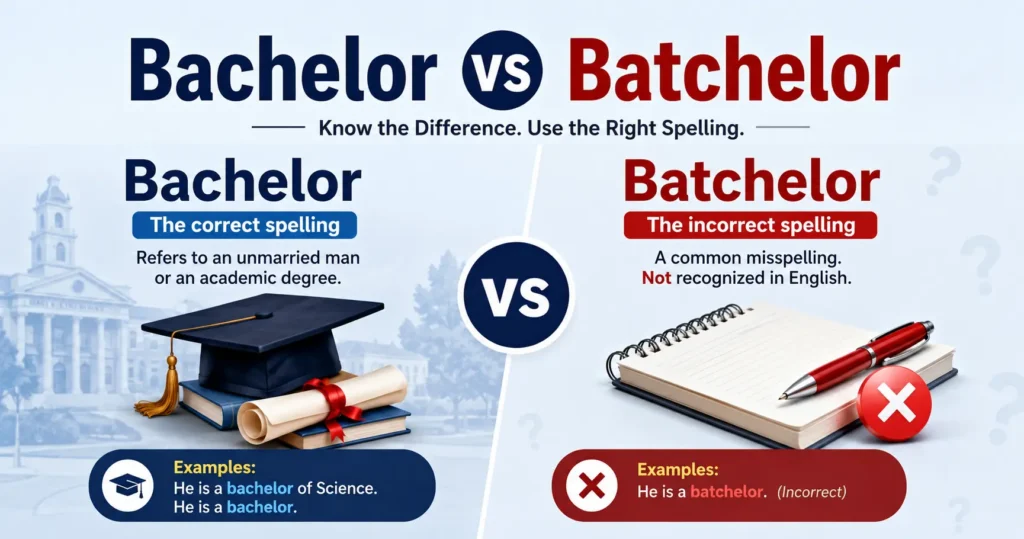
“Bachelor” is the correct spelling in modern English. “Batchelor” is a misspelling and is not accepted in American or British English today. The confusion happens because the word sounds like it starts with “batch,” which leads many writers to insert an extra letter “t.” Always use “bachelor” in all writing, whether you are referring to an unmarried man or a bachelor’s degree.
What Is the Correct Spelling: Bachelor or Batchelor?
The correct spelling is bachelor. “Batchelor” is a misspelling. It is not the right form in any modern standard English writing.
Major dictionaries confirm this clearly. The Cambridge Dictionary defines “bachelor” as the accepted English word. Merriam-Webster also lists only “bachelor” as the standard spelling with no alternative forms recognized in modern use.
Here is a quick example of correct usage:
“He is a confirmed bachelor who lives alone in the city.”
If you have been writing “batchelor,” you are not alone. This is one of the most common spelling mistakes in English. But now you know the correct form: always write bachelor, never batchelor.
What Does “Bachelor” Mean?
The word “bachelor” has two main meanings in modern English.dictionary.
- An unmarried man. This is the everyday meaning most people know. Example: “My uncle is a bachelor who travels the world.”
- A person who holds a bachelor’s degree. This is the academic meaning. Example: “She is a bachelor of science.”
Both meanings come from the same Old French root word: bacheler. This word meant a young knight or a man training to become a knight. The word moved into Middle English in the 14th century and kept both its social and academic meanings over time.
Knowing these two meanings helps you use the word correctly in every situation, whether you are writing a formal essay or a casual message.
Why Do So Many People Misspell It as “Batchelor”?
This is a great question, and the answer has to do with how English sounds.
When you say the word “bachelor” out loud, the first part sounds a lot like the English word “batch.” Your brain hears “batch” and tells your fingers to type a “t.” This is called a phonological spelling trap. It happens when the pronunciation of a word makes a wrong spelling feel right.
This kind of spelling confusion is very common in the English language. Think of how many people write “definately” instead of “definitely,” or “accomodate” instead of “accommodate.” The sound of the word misleads the writer.
It is also important to know that “batchelor” is not a British English variant. Some people think it might be a regional spelling used in the UK. It is not. Wiktionary does note that “batchelor” appeared in some archaic British texts from the early 1800s, including a 1814 novel by Walter Scott. However, that form is now completely obsolete and is not used in any formal or informal writing today.
So if you see “batchelor” in a very old book, that explains it. In all modern writing, it is simply a spelling mistake.
A Simple Trick to Remember the Correct Spelling
Here is a mnemonic device that makes it easy to remember the correct spelling forever:
“A bachelor has no commitment, and the word has no T.”
Say it once. Say it twice. The word bachelor has no “t” in it, just like a stereotypical bachelor avoids commitment.
Here is a second option if you prefer a letter-by-letter approach:
“bach + e + lor = bachelor”
Break it into three parts: bach, then e, then lor. No “t” appears anywhere in those three parts. Once you see it this way, the correct spelling becomes very easy to lock into memory.
Use whichever trick works best for you. Both of them make sure you never have to second-guess this spelling again.
How to Spell Bachelor’s Degree Correctly
Many writers who search for “bachelor vs batchelor” are also unsure about how to write the degree title. Here is a quick breakdown of the three forms you will see, with only one being correct in formal writing.
| Form | Correct? | Notes |
| bachelor’s degree | Yes | Apostrophe before “s” is required in formal writing |
| bachelors degree | No | Missing apostrophe makes this incorrect in formal use |
| bachelor degree | Informal only | Used as an adjective form; not correct in formal contexts |
The reason “bachelor’s degree” uses an apostrophe is simple. It is a possessive form. The degree belongs to the level of a bachelor. GrammarBook confirms this rule: the apostrophe is required because the phrase originally meant “a degree of a bachelor.”
In formal writing, academic papers, and resumes, always write bachelor’s degree with the apostrophe. Both “bachelors degree” and “bachelor degree” are informal shorthand forms that should be avoided in professional documents.
Is “Batchelor” Ever the Correct Spelling?
As a common English word, “batchelor” is never correct in modern writing. However, there is one important exception you should know about.
“Batchelor” with a capital B is a valid British surname. This means it is a proper noun used as a family name. A well-known example is Denzil Batchelor, a British sports journalist who wrote about cricket and boxing in the 20th century.
This surname causes confusion. When people see “Batchelor” in a newspaper or a book as a person’s last name, they sometimes think the spelling of the ordinary English word must also be “batchelor.” That thinking is incorrect.
Here is the simple rule to remember:
Batchelor (capital B) = a valid British surname.
batchelor (lowercase b) = always a misspelling in modern English.
As Wiktionary notes, the lowercase archaic form last appeared in common use around 1814. No modern dictionary or style guide accepts it as a standard spelling today.
Frequently Asked Questions
Is “batchelor” ever a correct spelling?
No. “Batchelor” is not a correct spelling in modern English. It appeared in some archaic British texts before the 19th century but is now completely obsolete. The only accepted spelling today is “bachelor.” Use “bachelor” in all formal and informal writing.
What is the difference between “bachelor” and “batchelor”?
There is no functional difference. “Batchelor” is simply a misspelling of “bachelor.” The confusion comes from the way the word sounds, because the first part resembles the English word “batch.” In all modern English writing, “bachelor” is the only correct form.
How do you spell “bachelor’s degree” correctly?
The correct form is “bachelor’s degree” with an apostrophe before the “s.” It is a possessive phrase that means a degree at the level of a bachelor. Both “bachelors degree” and “bachelor degree” are incorrect in formal writing.
Is “Batchelor” a valid surname?
Yes. “Batchelor” with a capital B is a valid British surname. It is a proper noun, not a common English word. Do not confuse the surname with the spelling of the ordinary word “bachelor,” which never uses a “t” in modern English.
Why do people misspell “bachelor” as “batchelor”?
People misspell “bachelor” because the word sounds like it begins with “batch,” a real English word. This tricks writers into adding a “t” where none belongs. It is a phonological spelling trap, not a regional or dialect difference.
What is the plural of “bachelor”?
The plural of “bachelor” is “bachelors” with no apostrophe. Example: “Three bachelors shared the apartment.” The apostrophe form “bachelor’s” is only used in the degree context, such as “bachelor’s degree,” or to show possession.
Final Thoughts
The answer to the “bachelor vs batchelor” question is clear and simple. Bachelor is always correct. Batchelor is always a spelling mistake in everyday modern English writing, whether you are writing about an unmarried man or a bachelor’s degree. The only time “Batchelor” is valid is as a British surname, and in that case it is always capitalized as a proper noun.
Now that you know the correct spelling, the reason behind the confusion, and a memory trick to help it stick, you will never second-guess this word again. Good spelling builds trust in your writing. It shows your reader that you take accuracy seriously.
If you enjoyed this guide, explore more spelling and grammar clarification articles on CorrectEnglish.org. Small spelling wins add up to big improvements in your writing confidence. Keep going!