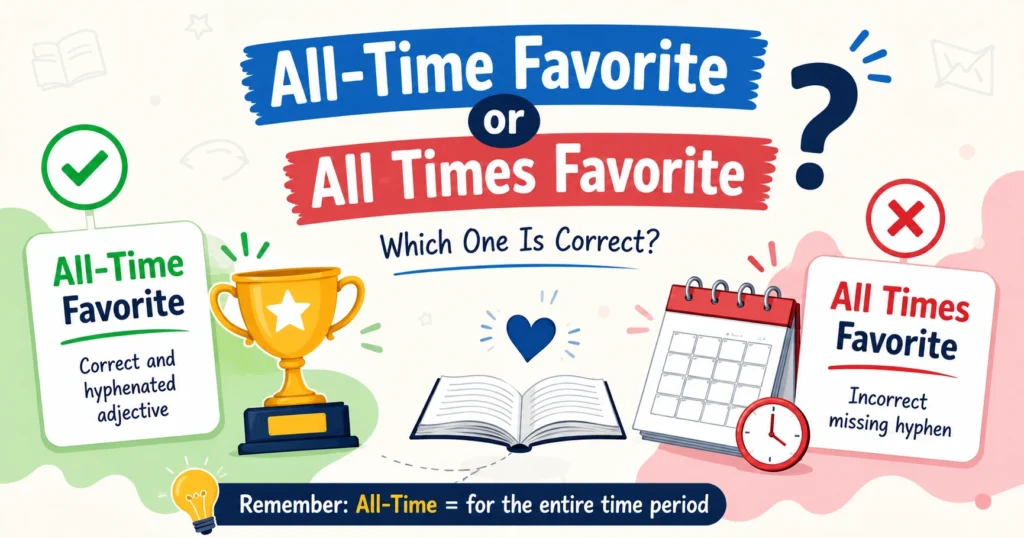
“All-time favorite” is the correct phrase. It uses a hyphenated compound adjective where “all-time” modifies the noun that follows. “All times favorite” is always grammatically incorrect because the plural form “times” does not work in this construction. In formal writing, always write “all-time favorite” with a hyphen. The unhyphenated form “all time favorite” is common in speech but technically incorrect in written English.
Have you ever typed “all times favorite” and stopped to wonder if it looked right? You are not alone. Millions of writers, students, and English learners pause at this exact phrase every day. The good news is that the answer is simple and clear.
The correct phrase is all-time favorite. “All times favorite” is never correct in standard English. Once you understand the short grammar rule behind it, you will never second-guess yourself again. This article gives you the direct verdict, explains the rule in plain terms, and shows you exactly how to use the phrase in your own writing.
Which Is Correct: “All-Time Favorite” or “All Times Favorite”?
The correct form is all-time favorite. “All times favorite” is grammatically incorrect in every context, whether you are writing formally or casually.
Here is a quick three-way comparison so you can see the difference at a glance:
| Form | Status | Example |
| all-time favorite | CORRECT | “This is my all-time favorite song.” |
| all time favorite | INFORMAL | Common in speech, but avoid in writing |
| all times favorite | INCORRECT | Never correct in any context |
The word “time” in this phrase is not a countable noun, so you cannot pluralize it into “times.” Think of it the same way you would think of saying “all days best” instead of “all-time best.” The plural form simply does not fit.
When you write “all-time favorite,” the hyphen connects the two words into a single adjective phrase. That joined phrase then modifies the noun that follows it, such as “movie,” “song,” “book,” or “place.”
Here are two correct example sentences to make it clear:
- “She said that pizza is her all-time favorite food.”
- “That was an all-time favorite moment for the whole team.”
Notice how “all-time” works together as one unit before the noun. This is exactly what a compound adjective does in standard English.
Why “All-Time” Takes a Hyphen
The reason “all-time” is hyphenated comes down to a foundational rule of English grammar: compound adjectives are hyphenated when they appear before a noun.
A compound adjective is simply two or more words that join together to describe a noun. The hyphen is the signal that tells the reader to read those words as one idea, not as two separate words.
Here are a few common examples of this same rule in action:
- well-known author (not “well known” before the noun)
- up-to-date information (not “up to date” before the noun)
- all-time favorite (not “all time” before the noun)
In each case, the words are joined by a hyphen because they work as one modifier. Remove the hyphen, and you introduce unnecessary confusion into the sentence.
This rule applies every time you use “all-time” as an adjective phrase before a noun. It is not optional in formal writing. The hyphen is part of correct grammar usage, and grammar tools like Grammarly and QuillBot will flag the missing hyphen and recommend the corrected form.
When “All Time” Stays Unhyphenated
There is one situation where you do not need a hyphen: when “all time” follows the noun as part of a noun phrase after a verb.
Compare these two sentences:
- “It is my all-time favorite film.” (compound adjective before the noun, hyphen required)
- “That film is the best of all time.” (noun phrase after the verb, no hyphen needed)
In the second sentence, “all time” is not acting as an adjective. It is a noun phrase sitting after the verb. No hyphen is needed because the two words are not joining together to modify a noun directly. The position in the sentence decides whether to hyphenate.
“All-Time Favorite” vs. “Favorite of All Time”: Are Both Correct?
Yes, both are grammatically correct. However, they work differently in a sentence, so they are not always interchangeable word for word.
Here is the core difference:
“All-time favorite” is a compound adjective that comes before the noun it describes:
- “He played his all-time favorite song at the concert.”
“Favorite of all time” is a noun phrase that comes after the verb in the sentence:
- “That song is his favorite of all time.”
Both sentences express the same idea. However, the structure changes based on where the phrase sits in the sentence. The first form uses the hyphenated adjective phrase. The second form uses an unhyphenated noun phrase.
Here is a side-by-side comparison to make the distinction easy to remember:
| Usage Type | Form | Example Sentence |
| Before the noun (adjective) | all-time favorite | “She is my all-time favorite author.” |
| After the verb (noun phrase) | favorite of all time | “She is my favorite author of all time.” |
| Incorrect in both positions | all times favorite | Never use this form |
Once you know where the phrase falls in your sentence, choosing the correct form becomes automatic.
“Favourite” vs. “Favorite”: A Quick Note on Spelling
If you are writing in British English, you will spell the word as favourite. If you are writing in American English, you will spell it as favorite. Both spellings are correct. The difference is simply regional, not a grammar error.
The hyphenation rule for “all-time” applies equally to both spellings. So whether you write “all-time favourite” or “all-time favorite,” the grammar rule is exactly the same.
How to Use “All-Time Favorite” Correctly: 10 Example Sentences
Reading examples is one of the best ways to lock a grammar rule into your memory. Here are ten natural, real-world sentences using “all-time favorite” correctly:
- “This Italian restaurant is my all-time favorite place to eat.”
- “The coach called it the team’s all-time favorite pregame ritual.”
- “She wore her all-time favorite blue dress to the party.”
- “That science fiction novel is my all-time favorite book from childhood.”
- “The crowd cheered when the band played their all-time favorite track.”
- “He still considers that old video game his all-time favorite way to relax.”
- “The teacher said that grammar was her all-time favorite subject to teach.”
- “That sunset over the mountains was an all-time favorite memory for the whole family.”
- “She ranked it as her all-time favorite vacation of her entire life.”
- “The bakery’s chocolate cake has always been an all-time favorite among regulars.”
In every sentence above, notice that “all-time” is hyphenated and placed directly before the noun it describes. That is the correct structure every time. The adjective phrase stays joined, the hyphen stays in place, and the noun follows right after.
Final Thought
Getting small grammar details right makes your writing cleaner, more professional, and easier to read. The rule here is short and easy to remember.
Use all-time favorite with a hyphen whenever the phrase comes before a noun. Use favorite of all time without a hyphen when the phrase comes after the verb. And never use “all times favorite” because it is always incorrect in standard English.
If you want to make sure your writing is error-free before you publish, try running it through a grammar checker. Tools like Grammarly and QuillBot catch issues like missing hyphens and incorrect adjective forms automatically, which saves you time and keeps your writing sharp.
For more grammar rules explained in plain English, explore the other articles on CorrectEnglish.org. Clear, correct writing is only a few clicks away.