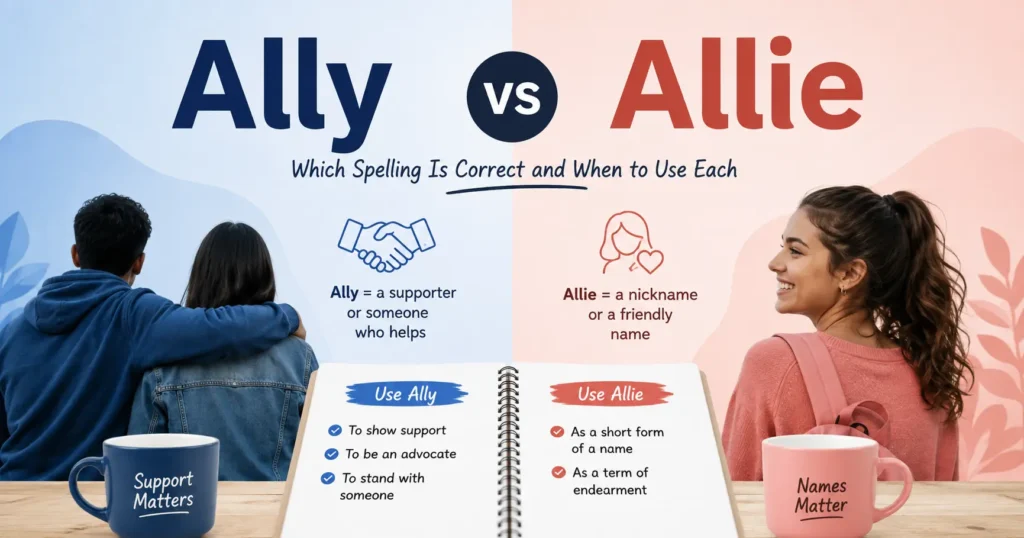
“Ally” and “Allie” are two completely different words with different meanings and grammatical roles. “Ally” with a lowercase Y is a common English noun and verb. It means a person or group that helps and supports another toward a shared goal. “Allie” with an IE ending is a proper noun. It is a personal name or nickname, most often short for Alice, Alison, or Alexandra. Using “Allie” to mean a supporter is a grammar error.
Should you write “ally” or “Allie”? If that question stopped you mid-sentence, you are not alone. These two words look and sound almost identical, but they are not the same word at all.
In this guide, you will learn what each word means, what grammatical role each one plays, when to capitalize and when not to, and the most common mistakes writers make with these two words. By the end, you will know exactly which one to use every time.
What Is the Difference Between Ally and Allie?
“Ally” and “Allie” are not two spellings of the same word. They are two completely different words.
“Ally” is a common English noun and verb. It means a person, group, or country that supports or helps another for a shared purpose. Merriam-Webster and Cambridge Dictionary both confirm this definition.
“Allie” is a proper noun. It is a personal name used as a first name or nickname. It has no dictionary meaning as a common English word. Using “Allie” in a sentence when you mean a supporter or partner is a spelling and grammar error.
Here is the quickest way to see the difference:
- “She is a trusted ally at work.” (common noun, lowercase)
- “Allie joined our team last week.” (proper noun, capitalized name)
One word names a relationship. The other names a person. They are not interchangeable.
What Does “Ally” Mean?
“Ally” is a standard common English word with a clear dictionary definition. It functions as both a noun and a verb in everyday English writing.
Ally as a Common Noun
As a common noun, “ally” means a person, group, or country that provides help, support, or cooperation to another for a shared purpose. Cambridge Dictionary classifies it as a C1-level English word, meaning it is used by confident and advanced English speakers.
Dictionary.com also includes a modern social definition: an ally is a person outside a marginalized or politicized group who actively supports and advocates for that group. This sense of the word is widely used in workplace communications and social discussions today.
The plural form of ally is allies. For example:
- “She has always been a loyal ally in the office.”
- “The two countries became close allies during the conflict.”
- “As an ally, he always spoke up for his teammates.”
The word “ally” is never capitalized in the middle of a sentence unless it starts the sentence. It is a common noun, not a proper noun.
Ally as a Verb
“Ally” also works as a verb. It means to unite with or join forces with another person or group for a common purpose. This is a C2-level usage, meaning it is used in more formal or advanced writing.
For example:
- “She decided to ally herself with the reform movement.”
- “The smaller nations chose to ally with each other for protection.”
The name “Allie” can never function as a verb. Only the common word “ally” carries that meaning.
What Does “Allie” Mean?
“Allie” is a proper noun. It is a personal name or nickname used for a real person. Because it is a proper noun, it is always capitalized, no matter where it appears in a sentence.
“Allie” is most commonly a shortened form of female names like Alice, Alison, or Alexandra. It can also occasionally serve as a nickname for male names like Alfred, Albert, or Alan.
According to Ancestry.com, the name “Allie” comes from English origins and has historically been used as a diminutive or nickname for names beginning with the letters AL.
Here are two example sentences using “Allie” correctly as a proper noun:
- “Allie started her new job on Monday.”
- “Can you ask Allie to join the meeting?”
Notice that “Allie” is always capitalized. This is the clearest visual signal that it is a proper noun and a personal name, not a common English word.
“Allie” has no dictionary meaning as a word for support, partnership, or cooperation. If you write “She is my Allie at work,” that sentence contains a capitalization and word-usage error. The correct word in that context is “ally” with a lowercase Y.
Ally vs Allie: A Side-by-Side Comparison
Here is a quick reference to see the key differences between both words at a glance.
| Feature | Ally | Allie |
| Word type | Common noun and verb | Proper noun (personal name) |
| Meaning | A supporter, partner, or helper | A personal name or nickname |
| Capitalized? | Only at the start of a sentence | Always capitalized |
| Plural form | Allies | No plural form (it is a name) |
| Verb form? | Yes (to ally yourself with) | No |
| Dictionary definition? | Yes – Merriam-Webster, Cambridge, Dictionary.com | No – it is a name, not a dictionary word |
| Example sentence | “She is a loyal ally.” | “Allie joined the project team.” |
This table covers every situation you are likely to encounter. Save it or bookmark it for quick reference the next time you need to choose between the two.
Name Spelling Variants: Allie, Ally, Ali, and Aly
The personal name that sounds like “al-ee” has four common English spelling variants. All four are acceptable as personal names:
- Allie – The most common spelling for girls’ names in the US. Ends in IE.
- Ally – A common spelling but one that creates visual confusion with the common noun “ally.”
- Ali – Often associated with both boys’ and girls’ names. Also a common Arabic name.
- Aly – The least common variant in English-language naming records.
According to Wikipedia, “Ally” is a unisex given name and nickname used as a diminutive of Alison and other names beginning with Al. Nameberry notes that the spelling “Ally” ranks behind “Allie” in US name popularity, likely because readers more easily associate the “ally” spelling with the common English word.
If you are choosing a name spelling for a child, all four variants are grammatically acceptable as proper nouns. If you are writing a sentence about a supporter or partner, none of these name spellings apply. The word you need is always “ally” with a lowercase Y.
Common Mistakes to Avoid With Ally and Allie
Two errors come up again and again with these two words. Here is how to spot them and fix them.
Mistake 1: Using “Allie” when you mean the common noun “ally”
This error usually happens because the writer has seen the name “Allie” before and associates the IE spelling with the word. It is incorrect.
Incorrect: “She is my Allie in the project.”
Correct: “She is my ally in the project.”
“Ally” in this sentence is a common noun naming a relationship. It is never capitalized in the middle of a sentence.
Mistake 2: Writing “ally” in lowercase when referring to a person named Allie
This error goes the other way. The writer knows the word “ally” is lowercase and applies that rule to the name too.
Incorrect: “Please contact ally about the meeting.”
Correct: “Please contact Allie about the meeting.”
“Allie” is a proper noun. A person’s name is always capitalized in English, regardless of where it appears in the sentence.
The quick check: ask yourself whether you are naming a real person or describing a relationship. If it is a person, capitalize it. If it is a role or relationship, use the lowercase common word “ally.”
Final Thoughts
The difference between ally and Allie comes down to one clear rule: word type.
“Ally” is a common English noun and verb. It means a supporter, partner, or helper. You find it in the dictionary. Its plural form is “allies.” You never capitalize it in the middle of a sentence. Merriam-Webster, Cambridge Dictionary, and Dictionary.com all confirm this definition.dictionary.
“Allie” is a proper noun. It is a personal name and nothing more. It is always capitalized. It cannot be used to describe a supporter or a working relationship.
Once you know the difference between a common noun and a proper noun, the ally vs Allie question answers itself every time. If you are writing about a relationship, a partnership, or a supporter, the word is always “ally.” If you are writing about a specific person who carries that name, the word is always “Allie.”
Now that you have mastered this word-usage clarification, you are ready to tackle other commonly confused English words that trip up even confident writers. Explore the full collection of word-confusion guides at CorrectEnglish for fast, clear answers to your toughest spelling and usage questions. Every guide follows the same plain-English approach: the right answer first, the reason why second, and the examples you need to apply the rule on your own.