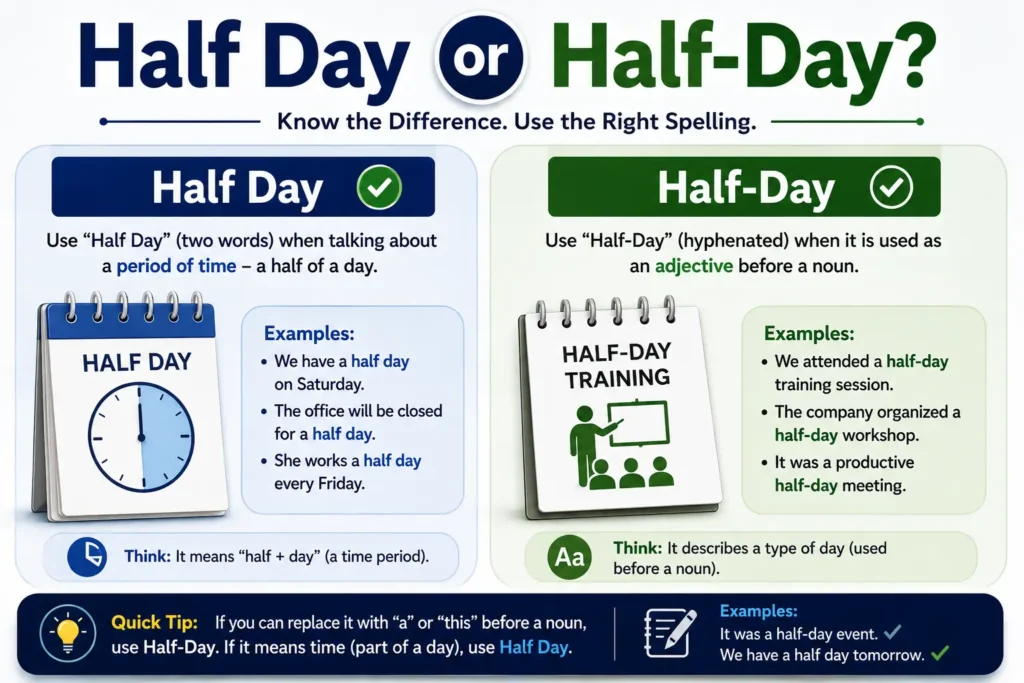
Both “half day” and “half-day” are correct in English, but they are used in different grammatical roles. “Half day” without a hyphen is a noun. It names a period of time. “Half-day” with a hyphen is a compound adjective. It describes another noun that comes right after it. So you take a half day off, but you attend a half-day meeting. The governing rule comes from both the AP Stylebook and the Chicago Manual of Style.
Should you write “half day” or “half-day”? If you stopped mid-sentence to wonder about that hyphen, you are not alone. This is one of the most common punctuation questions in everyday English writing.
Here is the good news. Both forms are correct. You just need to know which one fits your sentence. In this guide, you will learn the difference between the two forms, get a simple grammar rule you can use right away, and see the style guide backing from the AP Stylebook and the Chicago Manual of Style. By the end, you will never need to guess again.
Is “Half Day” Hyphenated or Not?
It depends on how you use the phrase in your sentence.
“Half day” without a hyphen is a noun. It names a specific block of time, roughly four hours, that makes up part of a standard workday. “Half-day” with a hyphen is a compound adjective. It works as a modifier that describes another noun coming right after it.
Both forms are grammatically correct in standard English. The AP Stylebook, the Chicago Manual of Style, and Cambridge Dictionary all confirm this. The only thing that changes is the grammatical role the phrase plays in your sentence.
Think of it this way. “Half day” and “half-day” are the same phrase doing two different jobs. Once you know the two jobs, the hyphen decision becomes simple every time.
When to Use “Half Day” Without a Hyphen
Use “half day” without a hyphen when it is the noun in your sentence. That means it is the thing you are talking about, not a word that describes something else.
A half day as a noun refers to a period of time covering approximately half of a standard workday. It is typically either the morning or the afternoon, usually around four hours. When you use it this way, it stands on its own. No hyphen is needed.
Here are three example sentences using “half day” as a noun:
- “She took a half day on Friday to run some errands.”
- “The training lasted a half day before breaking for lunch.”
- “Can I have a half day tomorrow afternoon?”
Notice that in each sentence, “half day” is the thing being taken, lasting, or requested. It is the noun. It stands alone. No noun follows it that it is describing. That is your signal: no hyphen needed.
The same noun rule applies to full time and full-time, and just like part time and part-time, the distinction follows the exact same logic across all similar compound phrases.
When to Use “Half-Day” With a Hyphen
Use “half-day” with a hyphen when it comes directly before another noun and describes what kind of thing that noun is. When two or more words work together to describe a noun before that noun, they form a compound adjective. Compound adjective hyphenation means you join the words with a hyphen to show they are working as one unit.
This is the standard compound modifier rule used across formal writing punctuation in English. Grammarly states it clearly: when a fraction like “half” is used as part of a compound adjective appearing before a noun, it should be hyphenated.
Here are three example sentences using “half-day” as a compound adjective:
- “We scheduled a half-day training session for the new staff.”
- “She requested a half-day shift on Monday mornings.”
- “The company offered a half-day workshop on workplace safety.”
In each sentence, “half-day” is telling you what kind of training, shift, or workshop it is. It is modifying the noun that follows it. That is the compound modifier at work. Add the hyphen.
What About “Half-Day” After the Noun?
Here is a nuance that most grammar articles miss. When “half-day” appears after the noun it describes, the hyphen is dropped. This is called the predicate adjective position in English grammar.
- “The training session was half day long.” (no hyphen – it comes after the noun)
- “The workshop was planned to be half day.” (no hyphen – predicate position)
When the phrase sits after the noun, there is no risk of confusion. The words no longer need to be joined. This rule follows the same post-nominal adjective pattern used in formal writing style guides.
The “What Kind Of?” Quick Test
If you are ever unsure whether to add the hyphen, use this simple three-step test. It works every time.
Step 1: Find the noun that comes after your phrase in the sentence.
Step 2: Ask the question, “What kind of _?” using that noun.
Step 3: If “half-day” answers that question, add the hyphen. If no noun follows and the phrase stands alone, skip the hyphen.
Here are three quick test examples:
Test: “She attended a half [day] meeting.”
Ask: What kind of meeting? A half-day meeting.
Answer: A noun follows the phrase. Add the hyphen. Write: “half-day meeting.”
Test: “He asked for a half-day shift.”
Ask: What kind of shift? A half-day shift.
Answer: A noun follows. Add the hyphen. Write: “half-day shift.”
Test: “She took a half day off.”
Ask: Is there a noun right after “half day”? No. “Off” is not a noun being described.
Answer: “Half day” stands alone as the noun. No hyphen. Write: “half day.”
Once this test becomes a habit, you will apply the compound modifier rule correctly every single time without needing to look it up again.
What the AP Stylebook and Chicago Manual of Style Say
Both major style guides support the compound adjective hyphen rule for phrases like “half-day.”
The Chicago Manual of Style states: “If you are using a phrase as a modifier, you will need hyphens to hold it all together.” However, it also notes: “There is no need for hyphens if you are using the phrase as a noun.” This is exactly the half day vs half-day grammar distinction covered in this article.chicagomanualofstyle
The AP Stylebook consistently uses hyphens in “half-” compound words. The stylebook lists examples including “half-life,” “half-moon,” “half-truth,” and “half-hearted” as standard hyphenated forms. This pattern confirms that “half-day” follows the same AP Style hyphen guidance when used as a modifier before a noun.apstylebook
Grammarly reinforces the same rule: “Any time two or more words become a single term to describe a noun, they are a compound adjective.” The hyphen is the signal that joins those words into one descriptive unit.grammarly
Together, the AP Stylebook, the Chicago Manual of Style, and Grammarly all point to the same conclusion. When “half-day” modifies a noun, use the hyphen. When “half day” stands alone as a noun, leave the hyphen out.
Quick Reference: “Half Day” vs “Half-Day” at a Glance
Here is a side-by-side comparison to help you decide quickly.
| Feature | Half Day (no hyphen) | Half-Day (with hyphen) |
| Grammatical role | Noun | Compound adjective |
| Hyphen needed? | No | Yes |
| Position in sentence | Subject or object of the sentence | Directly before a noun |
| What it does | Names a period of time | Describes what kind of noun it is |
| Example sentence | “She took a half day off.” | “She attended a half-day meeting.” |
| Style guide status | Noun: no hyphen needed | Modifier before noun: hyphen required |
| After the noun (predicate)? | No change: still no hyphen | Drop the hyphen in predicate position |
Save this table or bookmark this page. It covers every situation you are likely to encounter in everyday writing, formal documents, emails, and workplace communication.
Final Thoughts
The difference between half day and half-day comes down to one thing: the grammatical role the phrase plays in your sentence.
When “half day” is the noun, the thing you are naming, you skip the hyphen. When “half-day” is the compound adjective, the modifier sitting directly before another noun, you add the hyphen. The AP Stylebook and the Chicago Manual of Style both confirm this rule. Grammarly’s compound adjective guidance backs it up too.
Use the “what kind of?” test whenever you are unsure. It takes five seconds and gives you the right answer every time.
Now that you have the rule for half day and half-day, the same logic applies to dozens of other compound modifiers in English. Full time and full-time follow the exact same pattern. So does part time and part-time, long term and long-term, and short term and short-term.
For more fast, clear answers to English grammar and punctuation questions, explore the full collection of grammar guides and hyphenation rules at CorrectEnglish.org. Every guide is written to give you the right answer in plain, simple English so you can get back to writing with confidence.
Half Day or Half-Day: Which Is Correct?
Half day or half-day? Both are correct but used differently. Learn the noun vs adjective rule, the AP Style verdict, and a quick test to always get it right.