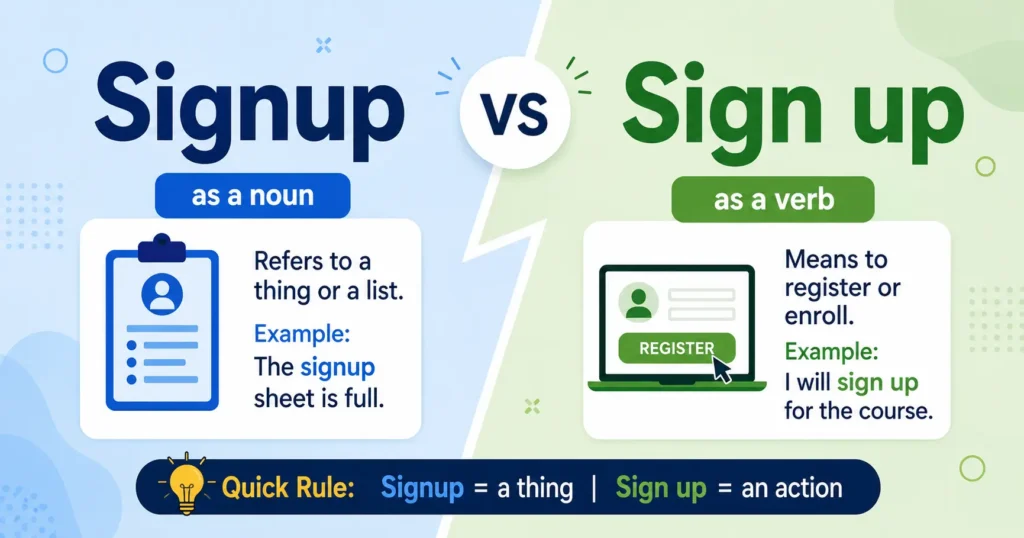
Backup and back up are both correct, but they perform different grammatical jobs. Use “backup” as a noun or adjective in standard writing. Use “back up” as a verb phrase. The hyphenated “back-up” exists in some dictionaries, but it is not the default modern choice. Follow this simple rule for technical writing: backup is a thing, and back up is an action.
What Is the Difference Between Backup and Back Up?
Should you write “backup your files” or “back up your files”? This is a very common spelling question. The pronunciation is exactly the same. The written forms perform completely different grammatical jobs. Choosing the right one changes the meaning of your sentence.
In this guide, you will learn the exact difference between backup vs back up. You will learn when to use backup as a single word and when to use back up as two words. We will look at whether back-up is correct and how to avoid the most frequent mistakes. By the end, you will know exactly which word choice to make for standard English.
Backup is normally a noun or adjective. Back up is a verb phrase. Use “I made a backup” when you name a copy or a reserve. Use “I need to back up my files” when you describe the action of creating a copy.
This is a core grammar rule in professional writing. The Microsoft Style Guide and Veeam both recommend this standard. They say the verb is two words and the noun is one word. If you struggle with this spelling, you are not alone. It behaves just like another one-word vs two-word English pair where the space changes the function.
| Form | Grammar role | Example |
| backup | noun | I made a backup. |
| backup | adjective | We need a backup plan. |
| back up | verb | Back up your files. |
When people ask, “backup or back up which is correct,” the answer always depends on the sentence. Are you naming a thing, or are you doing an action?
When Should You Use “Backup”?
Backup as a noun
The single word “backup” often works as a noun. A noun names a person, place, or thing. In this case, it means a copy, a reserve, extra support, or a substitute. Oxford Learner’s Dictionaries and Cambridge Dictionary both support these noun uses.
Examples:
- I made a backup of the document before the system update.
- We need a backup in case the main software fails.
- The police officer called for backup.
- I lost the backup copy of my presentation.
If you are describing a noun, use backup as a single word.
Backup as an adjective
You can use backup as an adjective to describe another noun. Cambridge Dictionary specifically documents “backup plan” as an adjective and noun combination.
Examples:
- The backup generator started automatically during the storm.
- Keep your backup files safe on a separate drive.
- We created a new backup system for the entire office.
When you wonder, “is backup one word,” check if it describes a thing. If it does, write it as a single word.
When Should You Use “Back Up”?
Use the two words “back up” when the phrase functions as a verb. A verb shows action. Oxford Learner’s Dictionaries and Cambridge Dictionary identify this form as a phrasal verb.
This action can mean creating a copy of computer data. It can also mean moving backward, supporting someone, or providing evidence. For example, “Back up your files” uses the phrase as a verb.
Examples:
- Please back up your files tonight.
- You should back up the car slowly out of the driveway.
- She will back up his story about the accident.
- The traffic backs up heavily during rush hour.
- Can you back up that argument with solid facts?
You will see the exact same pattern in similar one-word and two-word grammar pairs. The verb form almost always separates into two words. When readers ask, “is back up two words,” the answer is yes, as long as it functions as an action.
Is It “Backup Files” or “Back Up Files”?
Both forms appear in standard English, but they perform very different grammatical jobs. The correct choice changes based on what you want to say.
“Backup files” means files that serve as backups. Here, backup acts as an adjective.
“Back up files” means to perform the action of making copies. Here, back up is an action.
| Backup files (Adjective + Noun) | Back up files (Verb + Noun) |
| Keep your backup files in a secure location. | Remember to back up files before the update. |
| The backup files are corrupted. | I will back up files to the hard drive today. |
| Do you have the backup files ready? | Did you back up files from the old computer? |
People often search “back up files or backup files” because the space changes everything. Always ask yourself if you are describing the files or copying them.
Is “Backup Plan” or “Back Up Plan” Correct?
“Backup plan” is the standard modern form. In this phrase, “backup” modifies the noun “plan”. That means it functions as an adjective. “Back up” is a verb phrase and does not work in this position.
Examples:
- We need a backup plan for the outdoor event.
- Always have a backup plan ready just in case.
- Our backup plan worked perfectly when the power went out.
If you ever search “backup plan or back up plan”, remember that plans are things. You describe things with adjectives, which means you need the single word.
- Incorrect: We need a back up plan.
- Correct: We need a backup plan.
Is “Back-Up” Still Correct?
The hyphenated word “back-up” is a documented variant. You will see it in some British English texts and older writing styles. Collins Dictionary lists both backup and back-up as valid noun and modifier forms.
Many modern professional and technical style guides prefer “backup” for the noun and “back up” for the verb. The Veeam technical writing guide requires the closed noun and the separated verb. IETF terminology agrees with this rule.
Do not assume back-up is completely wrong. If your company style guide requires the hyphen, follow it. If you have no strict guide, use the standard one-word and two-word rules instead. If you search “backup vs back-up”, stick to the modern single word for the noun in standard American English.
What Are the Most Common Backup vs Back Up Mistakes?
Writers often mix up these forms when working fast. Understanding backup vs back up grammar helps you fix errors before you publish. This table shows the most frequent mistakes writers make with this word choice.
| Incorrect | Correct | Why |
| don’t forget to backup | don’t forget to back up | Verb phrase needed |
| a back up of the file | a backup of the file | Noun needed |
| a back up plan | a backup plan | Adjective needed |
| I need to backup my files | I need to back up my files | Verb phrase needed |
Reviewing your work catches these errors. They belong on the same list of common English mistakes that trip up smart writers every day. Always double-check your spelling against the grammatical function.
How Can You Remember Backup vs Back Up?
The easiest way to remember this rule is: Thing = backup. Action = back up.
When you write, stop and test your sentence.
- I have a backup. (Thing)
- I will back up my files. (Action)
- We need a backup plan. (Description of a thing)
- Please back up the computer. (Action)
This matches other common pairs like login vs log in. The single word is the noun. The two words form the verb. Testing for a “thing” or an “action” solves the problem instantly.
Backup vs Back Up: Quick Comparison
Use this quick reference table the next time you need to choose the right spelling.
| Form | Use | Example |
| backup | noun | I made a backup. |
| backup | adjective | We need a backup plan. |
| back up | verb | Back up your files. |
| back-up | variant | Follow your preferred style guide. |
Frequently Asked Questions
1. Is backup one word or two?
Backup is one word when it functions as a noun or adjective. For example, “I made a backup” and “We need a backup plan.” When the phrase functions as a verb, use two words: “Please back up your files.”
2. What is the difference between backup and back up?
Backup normally names a thing or describes something. Back up functions as a verb. “I saved a backup” uses the noun. “I backed up my files” describes the action of creating a copy.
3. Is it backup plan or back up plan?
Use backup plan in standard modern writing. “Backup” modifies the noun “plan”, so it functions as an adjective. “Back up” is the verb phrase, as in “We need to back up our files.”
4. Should I write backup files or back up files?
The correct form depends on your meaning. Backup files means files that are backups. Back up files means to create copies of files. The space completely changes the grammatical function.
5. Is back-up still correct?
Back-up is a documented variant in some dictionaries and styles. Many modern professional and technical style guides prefer backup for the noun or adjective and back up for the verb.
6. Can backup be a verb?
For standard professional and technical writing, use back up as the verb. Some dictionaries, such as Merriam-Webster, document broader usage. Follow the style guide required for your audience to ensure clear communication.
Learning the difference between backup and back up keeps your writing clear and professional. Remember that the single word is a thing, and the two words are an action. Keep practicing this rule until it feels natural. Still unsure about another confusing English word pair? Explore more grammar and usage guides from CorrectEnglish to build your writing skills.