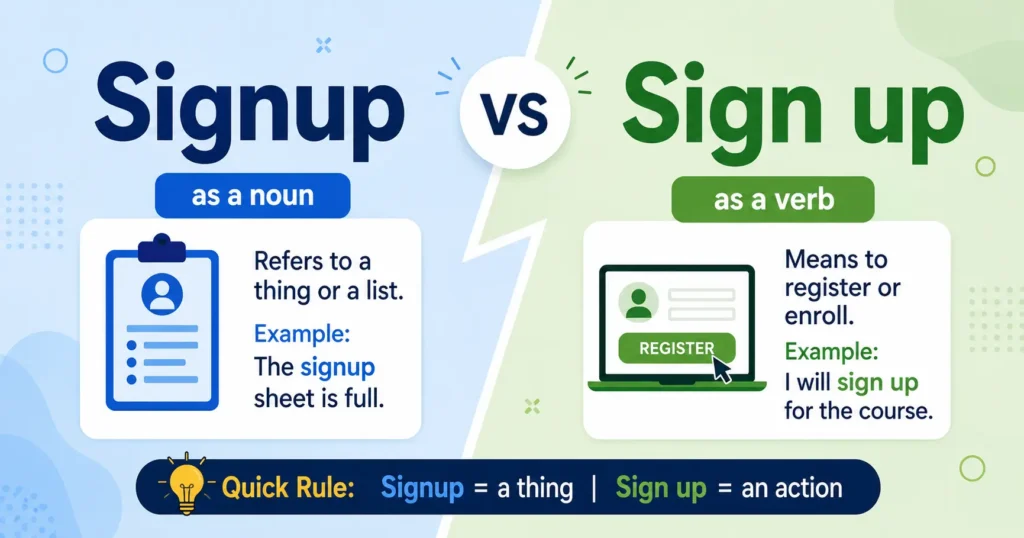
Use set up (two words) as a verb: to arrange, install, or prepare something, like “set up the printer.” Use setup (one word) as a noun or adjective: the arrangement or process itself, like “a simple setup” or “setup instructions.” British writing often hyphenates the noun as set-up, but the verb stays two words. Quick test: if “arrange” or “install” fits, write set up. If “arrangement” or “configuration” fits, write setup.
Introduction
You are typing an email, a menu label, or a note for a coworker. You reach the words set up vs setup and stop. Both look right. Both sound the same. Only the space is different, and that space changes the grammar.
This guide gives you the rule in plain words. You will learn what each form means, when the hyphen shows up, and how to test any sentence in seconds. You will also see the most common mistakes and try a short quiz.
Small slips add up. In a Global Lingo survey of 1,029 UK adults, 59% said they would not use a company that had obvious spelling or grammar errors. Google also asks site owners whether their content has spelling or style problems. Getting this pair right helps readers trust you.
What is the difference between set up and setup?
Set up is a two-word verb. It means to arrange, install, or prepare something. Setup is a one-word noun or adjective. It names the arrangement or the preparation itself. The spelling follows the grammar. If someone is doing the action, write set up. If you are naming the result or describing another noun, write setup.
Think of it as an action versus a thing. You set up a tent. The tent setup takes five minutes. The first sentence has a doer and an action. The second names a thing.
Here is the quick view:
| Form | Part of speech | Meaning | Example |
| set up | verb | to arrange, install, or prepare | We set up the room. |
| setup | noun | the arrangement or process | The setup took an hour. |
| setup | adjective | describes another noun | Read the setup guide. |
The two forms sound the same when you say them out loud. That is why the mix-up is so common. Only your spelling shows which word you mean.
Dictionaries and style guides agree on the split. Merriam-Webster lists setup as a noun and treats set up as the verb. The Microsoft Writing Style Guide says the same thing: two words as a verb, one word as an adjective or noun.
Each form also has a grammar label. Set up is a phrasal verb, which is a verb joined to a small word like “up.” Setup is a compound noun. Grammar books call it a closed compound, or solid compound, because two words became one. Set up stays an open compound, so it keeps its space.
Want more pairs like this one? Read our guide to commonly confused words.
When do you use “set up” as two words?
Write set up as two words whenever it works as a verb: “We set up the router,” “She is setting up a meeting,” “It was set up yesterday.” The pronoun goes in the middle: set it up, not set up it. The two-word form also works as a participial adjective after a linking verb: “The room is set up.”
Set up as a verb covers many jobs. The set up definition in most dictionaries lists a long set of senses, and Collins Dictionary is one example. Here are the common ones:
- Arrange: Please set up the chairs before the guests arrive.
- Install: He is setting up a new phone.
- Start: They set up a small shop on Main Street.
- Plan: Can you set up a call for Friday?
- Frame someone: The thief set him up to take the blame.
Set up is a transitive verb. That means it takes an object, which is the thing receiving the action. You can set up the room, or you can set the room up. Both are fine.
Set is also an irregular verb. Its past tense does not add -ed. It stays the same. Here are the forms:
| Form | Example |
| set up (present) | I set up the lab every morning. |
| sets up | She sets up the lab every morning. |
| set up (past) | We set up the lab yesterday. |
| setting up | They are setting up the lab now. |
| set up (past participle) | The lab has been set up. |
You may see set up as a phrasal verb with other small words too, like “set up for” or “set up with.” The core spelling stays two words. Our page on phrasal verbs explains how these verb and word pairs work.
Set up with a pronoun
Many phrasal verbs are separable. That means you can split the two parts with an object. When the object is a pronoun, you must split them. Say “set it up” or “set them up.” Do not say “set up it.”
Here are two examples:
- Wrong: I set up it last night.
- Right: I set it up last night.
Teachers, including those at the British Council, teach this word order rule for separable phrasal verbs. A full noun gives you a choice, but a pronoun does not.
Set up as an adjective
Set up can also act like an adjective. It comes from the past participle of the verb, so grammar books call it a participial adjective. You will see it after words like “is,” “was,” or “all.”
- The room is set up for the meeting.
- Everything was set up by noon.
- I am all set up and ready to go.
Here the two words still stay apart. The words describe the state of something after the action is done.
When do you use “setup” as one word?
Write setup as one word when it names a thing or describes a noun: “a clean desk setup,” “the setup took ten minutes,” “setup instructions.” It has a regular plural, setups. Setup can also mean a planned trick or the opening of a joke or story, but it is not the verb in standard English.
Setup as a noun
Setup as a noun names a thing. It can mean how items are arranged, or the process of getting something ready. Merriam-Webster defines it as the preparation and adjustment of a machine for a task, among other senses.
Here are some examples:
- Your desk setup looks great.
- The setup took ten minutes.
- Their camera setup has two lights and a tripod.
- The office setup gives everyone enough space.
The plural is setups, as in “We tested three setups.” The possessive adds an apostrophe, as in “the designer’s setup.”
So, is setup one word or two? As a noun or adjective, it is one word. Only the verb is two words.
Setup before another noun
Setup often comes right before another noun. Grammar books call this an attributive noun. It works like an adjective and tells you what kind of thing comes next. Use one word here too:
- Follow the setup instructions.
- Open the setup guide.
- Run the setup program.
- The setup time is about fifteen minutes.
Merriam-Webster shows this pattern with the phrase “setup tool.” The Microsoft Writing Style Guide gives a similar example with “setup time.”
Other meanings of setup
Setup has a few other meanings. In casual speech, a setup can be a situation planned to trick or trap someone. In a story or joke, the setup is the opening that leads to the punchline or payoff. Collins Dictionary and Merriam-Webster list both senses.
Even with these extra meanings, setup never becomes the verb.
Is “set-up” with a hyphen correct?
The hyphenated set-up is a British variant of the noun and adjective. American English usually writes setup. The verb is never hyphenated. It stays set up in both varieties. Pick one spelling for the noun, follow your house style, and keep it the same across the whole page.
Here is the setup vs set-up split:
| Form | Use | Example |
| setup | American English noun or adjective | The setup is simple. |
| set-up | British English noun or adjective | The set-up is simple. |
| set up | verb in both | We set up the lab. |
Merriam-Webster says the noun is usually written as setup in American English and as set-up in British English. Cambridge Dictionary and Collins Dictionary also record both spellings, so neither one is a mistake. It is mostly a choice about your readers.
Style guides often settle the question for a team. This choice is called hyphenation, and each guide has its own rule. The Microsoft Writing Style Guide says not to hyphenate. Other guides, like the Chicago Manual of Style and the AP Stylebook, set their own rules, so check the one you follow.
Here is a simple way to choose:
- Writing for a US audience? Use setup.
- Writing for a UK audience? Set-up is fine. Setup is also common.
- Following a house style? Copy its rule exactly.
- Not sure? Pick one and use it every time.
The most important point is to stay consistent. If your first paragraph says setup and your last says set-up, readers will notice. Our page on American vs British spelling covers more differences like this one.
How can you tell whether to write setup or set up?
Try two swaps. If arrange, install, or prepare fits the sentence, use set up. If arrangement, configuration, or installation fits, use setup. A second check: if a, the, my, or your comes right before the word, it is acting as a noun, so write setup.
Follow these steps whenever you are stuck:
- Swap in a verb. Try “arrange” or “install.” If the sentence still works, write set up.
- Swap in a noun. Try “arrangement” or “configuration.” If that works, write setup.
- Check the word before it. If you see a, the, my, or your, write setup.
- Try the pronoun test. If “it” fits in the middle, as in “set it up,” you have a verb. Write set up.
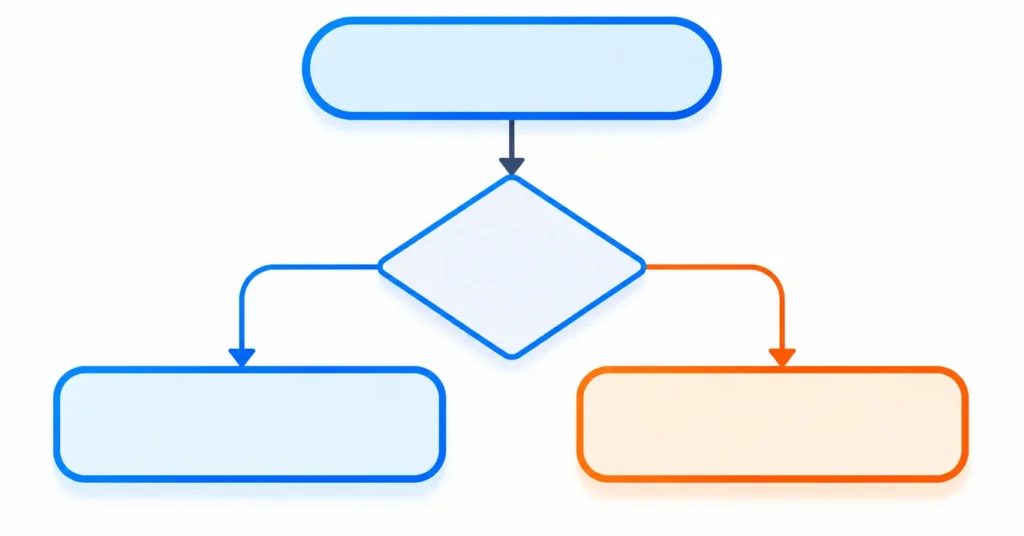
Here is the same idea in a table:
| Test | What it tells you | Write |
| “Arrange” or “install” fits | It is an action | set up |
| “Configuration” fits | It is a thing | setup |
| “A,” “the,” “my,” or “your” comes before it | It is a noun | setup |
| “It” fits in the middle | It is a verb | set up |
Let us try three sentences.
“Please ___ the router.” Arrange fits, so write “set up.”
“The router ___ was easy.” Configuration fits, so write “setup.”
“I like your gaming ___.” Your comes before it, so write “setup.”
This test works in emails, reports, school papers, and menu labels. It only takes a few seconds, and it works with any part of speech question you meet.
Common mistakes with set up and setup
Most errors come from using one form for both jobs. Here are the mistakes you will see most often.
| Incorrect | Correct | Why |
| Please setup the account. | Please set up the account. | It is an action, so use the verb. |
| I need to setup a meeting. | I need to set up a meeting. | A verb follows “to.” |
| Read the set up instructions. | Read the setup instructions. | The adjective is one word. |
| I setuped my laptop. | I set up my laptop. | The past tense does not add -ed. |
| The set up took an hour. | The setup took an hour. | It names a thing. |
Set up or setup an account?
Use “set up an account” for the action. Use “account setup” for the noun. You can say, “I need to set up an account,” and then, “Account setup takes two minutes.” The first sentence has an action. The second names a thing.
Set up or setup a meeting?
The same rule applies. You set up a meeting. You can also talk about the meeting setup. “Please set up a meeting for Monday” is correct. “The meeting setup was quick” is correct too.
Button labels and headings
Screen text follows the same rule. A button can say “Set up account” because it tells you to act. A heading can say “Account setup” because it names a topic. A menu item can say “Setup” if it names a tool or program. The Microsoft Writing Style Guide says to capitalize Setup when it names the actual Setup program.
Real teams fix these slips too. GitLab maintainers once opened a cleanup of set up and setup across their docs, code comments, and on-screen text. The Snowplow documentation style guide also lists set up as the verb and setup as the noun or adjective. If big software teams need to check this, it is fine if you do too.
A clear rule for titles
In title case, capitalize both words of the verb, as in “How to Set Up a Router.” Follow your house style for headings, because guides can differ.
Does the same rule apply to login, backup, and workout?
Yes. Many two-word phrasal verbs become one-word nouns or adjectives. The verb is two words. The noun or adjective is one. Check each pair in a dictionary, because a few keep a hyphen, such as check-in.
| Verb (two words) | Noun or adjective (one word) |
| set up | setup |
| log in | login |
| back up | backup |
| work out | workout |
Here are examples of each pair in a sentence:
- Log in to your account. Enter your login details.
- Back up your files. Keep a backup copy.
- I work out every morning. My workout takes thirty minutes.
The Microsoft Manual of Style uses the same split for back up and backup: two words as a verb, one word as a noun or adjective. Once you know the rule for one pair, you know it for many.
Read more in our guides to log in vs login and back up vs backup. You may also like everyday vs every day. That pair follows a different pattern, but it also depends on the space.
Quick practice: set up or setup?
Fill in each blank. Then check your answers below.
- Please ___ the projector before class.
- The ___ took ten minutes.
- Follow the ___ guide.
- She ___ her account last week.
- I like your desk ___.
- The room is already ___.
- Run the ___ program first.
- Can you ___ a meeting for Friday?
Answers:
- set up. It is an action.
- setup. It names a thing.
- setup. It describes “guide.”
- set up. It is the past tense verb.
- setup. It is a noun after “your desk.”
- set up. It is a participial adjective after “is.”
- setup. It describes “program.”
- set up. A verb follows “can.”
Got six or more right? You have the rule. Got fewer? Read the test section once more, then try again. Want more practice? Take our grammar quiz.
Frequently asked questions
Is setup a verb?
In standard English, no. Setup is a noun or adjective. When you mean the action, write set up as two words: “Please set up the software.”
What is the past tense of set up?
It is set up, unchanged, because set is an irregular verb. The other forms are sets up and setting up. For example: “We set up the room yesterday.”
Is it “set up an account” or “setup an account”?
Write “set up an account.” Here the words work as a verb. The noun forms are “account setup” and “account setup process.”
Is it “set up a meeting” or “setup a meeting”?
Write “set up a meeting.” It is an action, so use the two-word verb. You can also say “meeting setup” when you name the arrangement as a thing.
Is “set-up” wrong?
No. Set-up is a common British spelling of the noun and adjective, and some house styles use it. American English usually writes setup. Never hyphenate the verb.
Is setup one word or two?
It depends on the job. As a noun or adjective, setup is one word, as in “setup guide.” As a verb, it is two words: set up.
Does “setup” have other meanings?
Yes. Informally, a setup can be a situation planned to trick someone. In stories and jokes, the setup is the opening that leads to the punchline. The verb set up can also mean to frame someone.
Should I capitalize “Setup” in a title or on a screen?
In title case, capitalize both words of the verb: Set Up. The Microsoft Writing Style Guide capitalizes Setup only when it names the actual Setup program. Follow your house style for headings.
Keep the rule handy
Next time you reach the space bar, ask one question: is this an action or a thing? An action gets two words. A thing gets one. That one check covers nearly every sentence you will write.
Want to keep going? Browse more commonly confused words, or test yourself again with the grammar quiz.