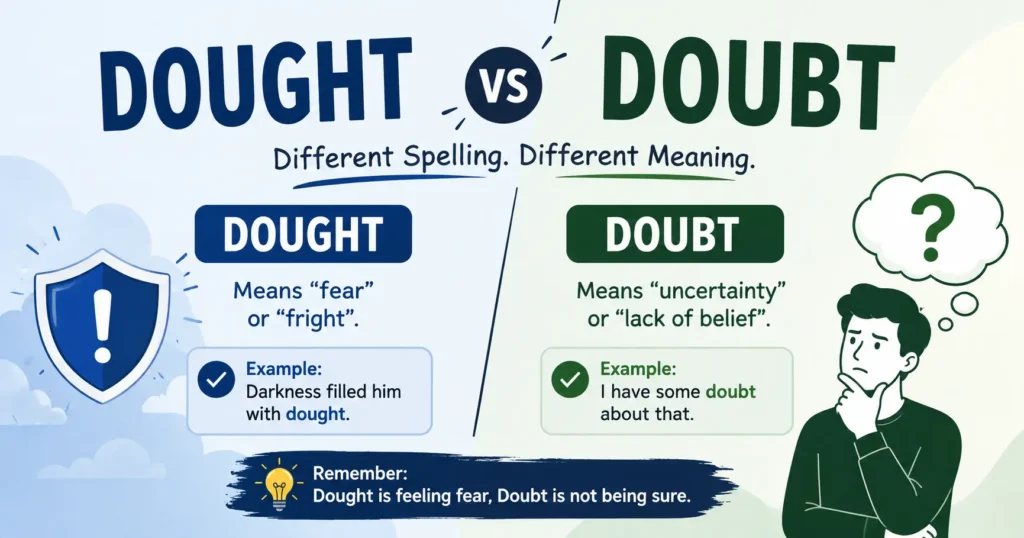
The correct spelling is doubt, not dought. Dought is not a recognized word in modern standard English. It may appear as an archaic form in very old texts, but it has no place in any writing today. Doubt comes from the Latin word dubitare and contains a silent B that is never pronounced. Use doubt whenever you want to express uncertainty, hesitation, or a lack of confidence.
Have you ever written the word dought and then stopped to wonder if that was right?
You are not alone. This is one of the most natural spelling mistakes in English. The word sounds like it should be spelled without a B, so many writers, students, and ESL learners type dought or even dout without thinking twice. The confusion makes complete sense.
In this guide, you will get a clear answer on the dought vs doubt question, find out why so many people make this spelling mistake, and learn exactly how to use the word doubt correctly in your writing.
Dought or Doubt: What Is the Correct Spelling?
The correct spelling is doubt.
Dought is not a recognized word in modern English. According to Merriam-Webster and Cambridge Dictionary, the only accepted spelling for this word is D-O-U-B-T. If you have been writing dought, you are making a common spelling mistake that is easy to fix once you know the rule.
The word doubt is used to express a feeling of uncertainty or a lack of confidence in something. It works as both a noun and a verb, and it appears in everyday English all the time.
What About “Dought” as an Archaic Word?
Dought does exist in very old English texts. It was an archaic Middle English form that occasionally appeared in historical writing. It also existed as a rare past tense of an old verb meaning “to be of worth.”
However, neither of these meanings has any place in modern English. You will never need to write dought in any school paper, professional document, or everyday communication. When you see the word dought today, it is almost always a misspelling of doubt. The correct word to use is always doubt.
Why Do People Write “Dought” Instead of “Doubt”?
The reason people write dought is simple: the word doubt is spelled differently from how it sounds.
When you say doubt out loud, it sounds like /daʊt/. It rhymes with the words out, shout, and trout. There is no B sound in the pronunciation at all. So when someone spells the word phonetically, writing down exactly what they hear, the result comes out as dout or dought.
This is a phonetic spelling error. It happens when a writer sounds a word out in their head and writes exactly what they hear. In English, this approach works for many words. But for words with silent letters, it leads to a spelling mistake.
The same thing happens with the word debt. People sometimes write det because the B in debt is also completely silent. Both doubt and debt have silent B letters for the same historical reason, which brings us to the next question.
Where Did the Word “Doubt” Come From?
The word doubt has a fascinating history, and that history explains exactly why the B is there even though you never say it.
Doubt entered English through Old French. The Old French word was douter, which meant to fear or to hesitate. Before that, it came from the Latin word dubitare, which meant to waver, to question, or to be uncertain about something.
In the early versions of the English word, there was no B. People wrote it as doute or dute, much closer to how it sounds today. Then, in the 1400s and 1500s, a group of Renaissance scholars decided to update English spelling to reflect Latin and Greek roots. They added a B to doubt to show its connection to the Latin dubitare. They did the same thing to debt, which comes from the Latin debitum, and to subtle, which comes from the Latin subtilis.
The pronunciation never changed. Only the spelling was updated. This is why the B in doubt is completely silent to this day. It is a spelling tribute to the Latin language, added by scholars centuries ago.
What Does “Doubt” Mean? Definition and Usage
Doubt is defined by Merriam-Webster as “to call into question the truth of; to be uncertain or in doubt about.” Cambridge Dictionary describes it as “a feeling of not being certain about something, especially about how good or true it is.”dictionary.
Doubt works as both a noun and a verb in everyday English. Understanding how to use each form correctly will make your writing clearer and more confident.
Doubt as a Noun
As a noun, doubt refers to a feeling of uncertainty or a lack of conviction. It describes the mental state of not being sure about something.
Example sentences:
- “I had some doubt about whether the information was correct.”
- “There is no doubt in my mind that she worked hard.”
- “His hesitation filled her with doubt.”
- “The new evidence cast some doubt on the original story.”
When used with the verb have, doubts is usually written in the plural form and followed by the word about. For example: “I have my doubts about his ability to finish the project on time.”espressoenglish
Doubt as a Verb
As a verb, doubt means to question something or to feel uncertain about it. It expresses a state of disbelief or lack of confidence in a claim, person, or situation.
Example sentences:
- “I doubt she will arrive on time.”
- “Do you doubt what I am telling you?”
- “He doubted his own ability to succeed.”
- “They doubted the results of the experiment.”
Both forms are used constantly in everyday English. Whether you are writing an email, a school essay, or a professional report, knowing which form to use will help you write with more clarity.
Common Phrases and Expressions Using “Doubt”
Doubt appears in many everyday phrases that you have probably heard or read before. Here are the most common ones with a quick example for each:
- No doubt – used to say something is very likely or certain: “She will no doubt find a solution.”
- Without a doubt – used to emphasize that something is definitely true: “He is without a doubt the best player on the team.”
- Beyond a reasonable doubt – used in legal writing to describe the highest standard of proof: “The jury must find the defendant guilty beyond a reasonable doubt.”
- Cast doubt on – used to make something seem less certain or reliable: “The new findings cast doubt on the earlier research.”
- Have doubts about – used to express uncertainty or concern: “I have doubts about the safety of that plan.”
- When in doubt – used to give advice for uncertain situations: “When in doubt, check the instructions again.”
These phrases are used in everyday writing, formal documents, legal settings, and casual conversation. Knowing them will help you use the word doubt with confidence in any context.dictionary.
Final Thoughts
The dought vs doubt question has a clear answer: doubt is the correct spelling, and dought is simply a misspelling.
Writing dought is an understandable mistake. The B in doubt is completely silent, and the word sounds nothing like its spelling. But now you know the reason: Renaissance scholars added that silent B centuries ago to honor the Latin root dubitare, and English has kept it ever since.
The next time you write about uncertainty, hesitation, or a lack of confidence, spell it D-O-U-B-T and move forward without a second doubt in your mind.
Want to sharpen your spelling even further? Explore more commonly misspelled English words and confusing word pairs on correctenglish.org. Small spelling fixes like this one add up to stronger, more professional writing every time.