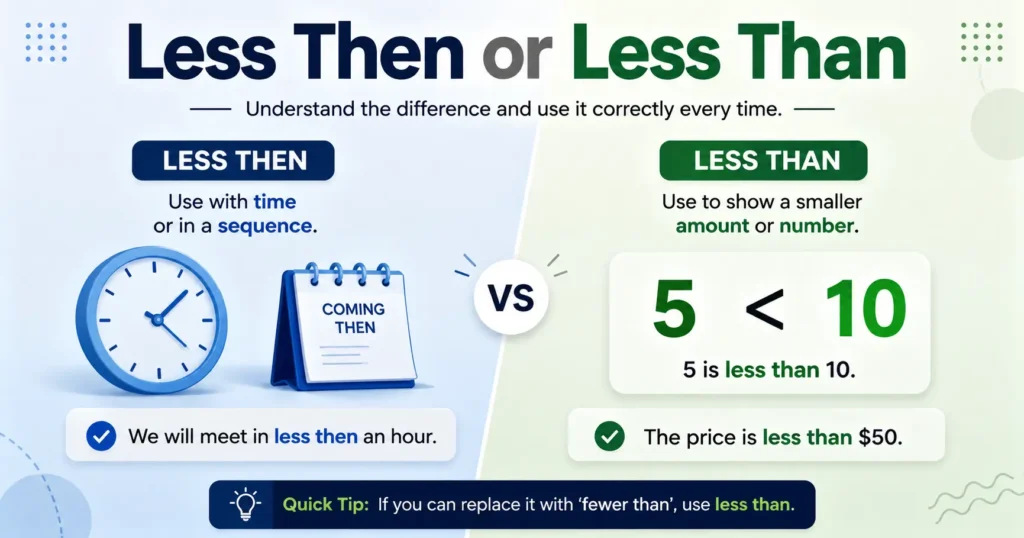
“Less than” is always the correct form in English. “Less then” is a spelling error and should never be used in writing. The confusion happens because “than” and “then” sound similar in speech. However, they do completely different jobs: “than” is used for comparisons, while “then” refers to time or sequence. Use “less than” whenever you are comparing amounts, numbers, distances, or measurements.
Have you ever typed “less then” in a sentence and then stopped to wonder if it looks right? You are not alone. This is one of the most common English writing mistakes people make every day. The good news is that the fix is simple. “Less than” is the correct phrase. “Less then” is always wrong. In this guide, you will learn exactly why, see clear examples, and understand the grammar rule so you never mix them up again.
Is It “Less Than” or “Less Then”?
The correct phrase is “less than.” The phrase “less then” is a grammar error and should never appear in your writing.
Here is a quick look at the difference:
| Form | Correct? | Example |
| Less than | YES | She earns less than he does. |
| Less then | NO |
“Than” is a comparative conjunction. It connects two things being compared. “Then” is an adverb or conjunction used to talk about time or what happens next. These two words are not interchangeable. Whenever you are comparing two amounts, values, or quantities, you must use “than,” not “then.”
This section is the most important thing to remember from this entire article. “Less than” is the only correct form. Full stop.
Why Do People Write “Less Then” by Mistake?
This is a very common English mistake, and the reason is simple. “Than” and “then” sound almost exactly the same when spoken, especially for non-native English speakers. In many accents, the vowel sounds in both words are nearly identical. So when people write quickly, they sometimes type what they hear rather than what the grammar rule requires.
This spelling error shows up all the time in casual writing, text messages, and even professional emails. If you have made this mistake before, you are in good company. Modern grammar checkers and AI writing tools now flag “less then” as an error automatically. That is actually a sign of how widespread this confusion is. Understanding why it happens is the first step to fixing it for good.
The Grammar Rule Behind “Less Than”
The grammar rule is straightforward. “Than” is always used for comparisons in English. It is a conjunction and preposition that connects two things being measured against each other.
The structure looks like this:
[Subject] + [verb] + less than + [reference point]
For example: “The bag weighs less than five kilograms.”
In this sentence, two amounts are being compared: the weight of the bag and five kilograms. That comparison requires the word “than,” not “then.”
This rule applies to every kind of comparison: amounts, measurements, money, time, and distance. “Then” only works when you are talking about a sequence of events or a point in time, such as “We finished dinner and then watched a movie.” Since “less than” is always about comparison, “then” simply has no place in that phrase. According to Merriam-Webster, “than” is the standard conjunction for all comparative structures in English.
How to Use “Less Than” in a Sentence (With Examples)
Seeing the rule in real sentences makes it much easier to remember. Here are clear examples across different everyday contexts.
Everyday Use
- Money: The book costs less than ten dollars.
- Time: The trip takes less than an hour.
- Distance: The store is less than one mile away.
- Quantity: There are less than twenty students in the class.
- Weight: The package weighs less than two pounds.
Formal and Academic Use
- Statistics: Less than thirty percent of respondents agreed with the statement.
- Science: The temperature dropped to less than zero degrees Celsius.
- Professional writing: The project was completed in less than three business days.
All of these sentences follow the same pattern. Two values are being compared, so “than” is the correct word to use. Notice that “less then” would make zero sense in any of these sentences because none of them are talking about a sequence of time.
“Less Than” vs. “Fewer Than” — Is There a Difference?
This is a question many English learners ask after mastering “less than.” The short answer is: both are correct in most everyday situations, but there is a traditional grammar rule worth knowing.
According to Merriam-Webster, “fewer than” is traditionally preferred when you are talking about countable nouns, meaning things you can count one by one. “Less than” is traditionally used with uncountable nouns or measured amounts.
Here is a simple breakdown:
| Phrase | Best For | Example |
| Fewer than | Countable nouns (people, items) | Fewer than five people attended. |
| Less than | Uncountable amounts (time, money, water) | It cost less than twenty dollars. |
However, modern English widely accepts “less than” in both situations. Phrases like “less than three hours” and “less than 50 people” are completely standard in everyday speech and writing. Merriam-Webster confirms that “less than” is standard in many common phrases, including “12 items or less” and “an essay of 250 words or less.”
So while “fewer than” is slightly more precise for countable nouns in formal writing, using “less than” will rarely be considered wrong in everyday contexts.
Frequently Asked Questions
Is “less then” ever correct in English?
No. “Less then” is never correct in standard English. “Then” is an adverb or conjunction that refers to time or a sequence of events. It cannot be used in comparisons. The correct form is always “less than,” whether you are comparing numbers, amounts, distances, or time periods. There are no exceptions to this rule.
What is the difference between “than” and “then”?
“Than” is used for comparisons, such as “she is taller than me.” “Then” refers to time or sequence, such as “we ate dinner and then watched a movie.” These two words look and sound similar, but they serve completely different purposes. Always use “than” when you are making any kind of comparison in English.
When should I use “less than” in a sentence?
Use “less than” when comparing amounts, measurements, money, time, or distances. For example: “The project took less than an hour,” “It costs less than twenty dollars,” and “He lives less than five miles away.” In each case, “less than” shows that one quantity is smaller than another.
Is “lesser than” correct English?
No. “Lesser than” is not standard English. “Lesser” is an adjective meaning the smaller or inferior of two options, and it is never followed by “than” in a comparison. The correct comparative phrase is always “less than,” not “lesser than.” Using “lesser than” is considered a grammar error.
Can “less than” be used with countable nouns?
Yes, in most everyday contexts. While traditional grammar prefers “fewer than” for countable nouns, modern English widely accepts “less than” in common phrases involving money, time, and numbers. Merriam-Webster confirms this as standard usage in everyday English speech and writing.
What does “less than” mean in mathematics?
In mathematics, “less than” means a value is smaller than another value. It is represented by the symbol (<). For example, “5 < 10” means “5 is less than 10.” The phrase “less than or equal to” uses the symbol (<=) and includes the possibility of the two values being equal.
Quick Recap: The Rule in Plain Words
The rule is easy to remember with one simple trick:
THAN = comparison. THEN = time.
If you are comparing two things, always use “than.” If you are talking about what happens next or a point in time, use “then.” Since “less than” is always about comparing amounts, you will always need “than” in that phrase, never “then.”
Every time you write “less than,” you are using a comparative phrase. That means “than” is the only word that fits. “Less then” will never be correct because “then” has nothing to do with comparison. Keep this simple rule in mind, and you will never confuse these two words again.
Keep Improving Your Grammar
Now that you have mastered the “less than” rule, you are ready to tackle more common English confusable words. Understanding the difference between “than” and “then” opens the door to writing more clearly and with more confidence. Explore our full collection of grammar guides to fix the most frequent English writing mistakes one step at a time.